


Choosing between HRT and the pill for perimenopause symptoms can seem complicated—but it doesn't have to be. Both hormone therapy and combined hormonal contraceptives (CHC) are hormone medications that can have an impact on perimenopause symptoms, but they don’t work the same way. We'll explain how birth control in perimenopause differs from HRT, who each treatment is best for, and what to know about switching from the pill to HRT. And because there's no one-size-fits-all answer, know that a menopause-trained clinician, like one at Midi Health, can help guide you in finding the right solution for your needs.
To say midlife is confusing is an understatement. Just when hot flashes, mood swings, and sleep disruptions have you questioning your sanity, you also may still need to think about birth control. Fertility declines in your 40s, but pregnancy is still possible until you've officially reached menopause. And thanks to increasingly unpredictable periods, avoiding pregnancy can actually get trickier.
So if you're wondering whether to stay on a birth control pill or switch to hormone replacement therapy (HRT, now commonly referred to as menopause hormone therapy or MHT), you're not alone. Adding to the confusion is the fact that the pill may ease some perimenopause symptoms. It's no wonder many women are left feeling unsure about which hormonal treatment, if any, makes the most sense for them.
The reality is, the right choice isn't the same for everyone. When deciding whether you should take HRT or the pill for perimenopause, it’s important to know that they’re designed for different purposes and work in different ways. Hormonal contraceptives like the birth control pill primarily prevent pregnancy and suppress ovulation, while HRT supplements some of the hormones that your body’s producing less of to help manage perimenopause symptoms.
Finding the right fit depends on your symptoms, medical history, age, lifestyle, and of course, your personal preferences. Ahead, we'll compare birth control vs. HRT for perimenopause, including how they work, their key differences, and their impact on perimenopause symptoms. We’ll also cover what to know about switching from one to the other, if and when the time is right. You don’t have to navigate these decisions alone, either—a Midi clinician can help guide you through this confusing life stage.
Perimenopause Hormones 101: Why Symptoms Start
Perimenopause is the years-long transition leading up to menopause, and it often begins in your mid-40s. The average age of menopause is 52 in the U.S., although it can happen earlier or later.
During this time, your ovaries begin producing less estrogen and progesterone. But this is no smooth, orderly descent—levels rise and fall randomly. These hormonal swings are behind many of the hallmark symptoms and signs of perimenopause, like hot flashes, night sweats, sleep disruptions, a short emotional fuse, and irregular periods.
With all of these hormonal ups and downs happening, pregnancy may be the furthest thing from your mind. However, even if your periods are unpredictable, ovulation can still happen. That means pregnancy is still possible until you've officially reached menopause, defined as going 12 months in a row without a period.
This is where treatment options can get a little confusing. Two of the most common hormonal options during perimenopause are HRT and the birth control pill, which have different purposes. But we’re here to explain how HRT and the pill work, plus who might benefit from each option.
How the Birth Control Pill Works in Perimenopause
Preventing pregnancy, of course, is the birth control pill’s main claim to fame. But it can also help manage some of the hormonal shifts that make perimenopause feel downright dreadful sometimes.
Here's how: The birth control pill contains formulations of the female hormones estrogen and progesterone. Together, they make it harder for an egg to implant in your uterus and keep your hormone levels more consistent throughout the month. That same mechanism can help smooth out some of the biggest ups and downs of perimenopause.
Research shows that hormonal birth control can relieve many perimenopause symptoms, including:
- Menstrual irregularity
- Heavy menstrual bleeding
- Vasomotor symptoms like hot flashes, heart palpitations, and migraines
- Menstrual pain
Some women notice additional benefits, too. Depending on the formulation, the pill may help improve acne, reduce premenstrual symptoms, and give you the knowledge of when your next period will show up. It can also control unpredictable vaginal bleeding.
However, the pill may not be the best fit if you’re trying to understand where you are in your menopause journey. The monthly bleeds you experience while taking the pill are not the same as natural periods, and that can make it harder to determine when you’ve officially reached menopause or when it may be time to consider transitioning to another treatment option.
Birth control pills also contain higher doses of hormones than HRT. While many healthy women can safely use them through perimenopause, they may not be safe if you have certain risk factors (we’ll get to those in a minute). A healthcare professional, such as a Midi clinician, can help determine whether the pill is a safe option based on your individual health history.

How HRT Works in Perimenopause
HRT helps replenish some of the estrogen and progesterone your body is no longer making in order to relieve common perimenopause symptoms. But the doses and types of hormones in typical HRT aren’t exactly the same form and doses found in the pill.
"When we prescribe HRT, we're typically using bioidentical estradiol and progesterone, which are similar to the hormones your body naturally produces," says Heather Hofflich, DO, a Midi physician. "Birth control pills also contain estrogen and progesterone, but they're generally synthetic forms."
HRT is considered a first-line, FDA-approved treatment for bothersome hot flashes and night sweats, according to leading organizations like The Menopause Society. HRT offers other other benefits, too, like helping smooth out mood changes, improving sleep, and helping prevent bone loss. HRT isn’t a one-size-fits-all solution, either: There are different types of hormones, different ways to take them, and different reasons your clinician might recommend one option over another.
If you still have a uterus, hormone therapy typically includes both estrogen and progesterone. Estrogen helps relieve menopause symptoms, while progesterone protects the lining of the uterus. Without progesterone, estrogen can cause the uterine lining to become too thick over time, increasing the risk of endometrial (uterine) cancer.
But HRT does not prevent pregnancy. A trained clinician can help you determine whether and when to start HRT in perimenopause.
What Success Looks and Feels Like
HRT vs. the Pill: Key Differences
The birth control pill and HRT both contain hormones, but those hormones do different things. The pill uses higher doses of hormones to suppress ovulation, prevent pregnancy, and create more predictable cycles. On the other hand, HRT replaces some of the hormones your body is losing to help make the menopause transition a little less bumpy.
The dosage of hormones in a birth control pill is 3 to 5 times higher than the amount in HRT. That’s because it has a big job to do: sending a strong enough signal to the brain and ovaries to stop the monthly process that leads to egg release.
Another key difference: The pill provides contraception; standard HRT does not. So the right choice for you, when it comes to birth control vs. HRT in perimenopause, depends on where you are in the perimenopause journey, your symptoms, and whether pregnancy prevention is needed.
Because HRT doesn’t suppress ovulation the way birth control pills do, your menstrual cycle will continue. And while combination birth control pills can help make bleeding lighter and more regular, you may still deal with unpredictable or heavy bleeding during perimenopause if you take HRT.
When the Pill Might Be the Better Choice
For some women in perimenopause, the pill can be a hormonal multitasker. In addition to preventing pregnancy, it can also help tame some of the upheavals that come with changing hormones, especially if you’re still getting periods.
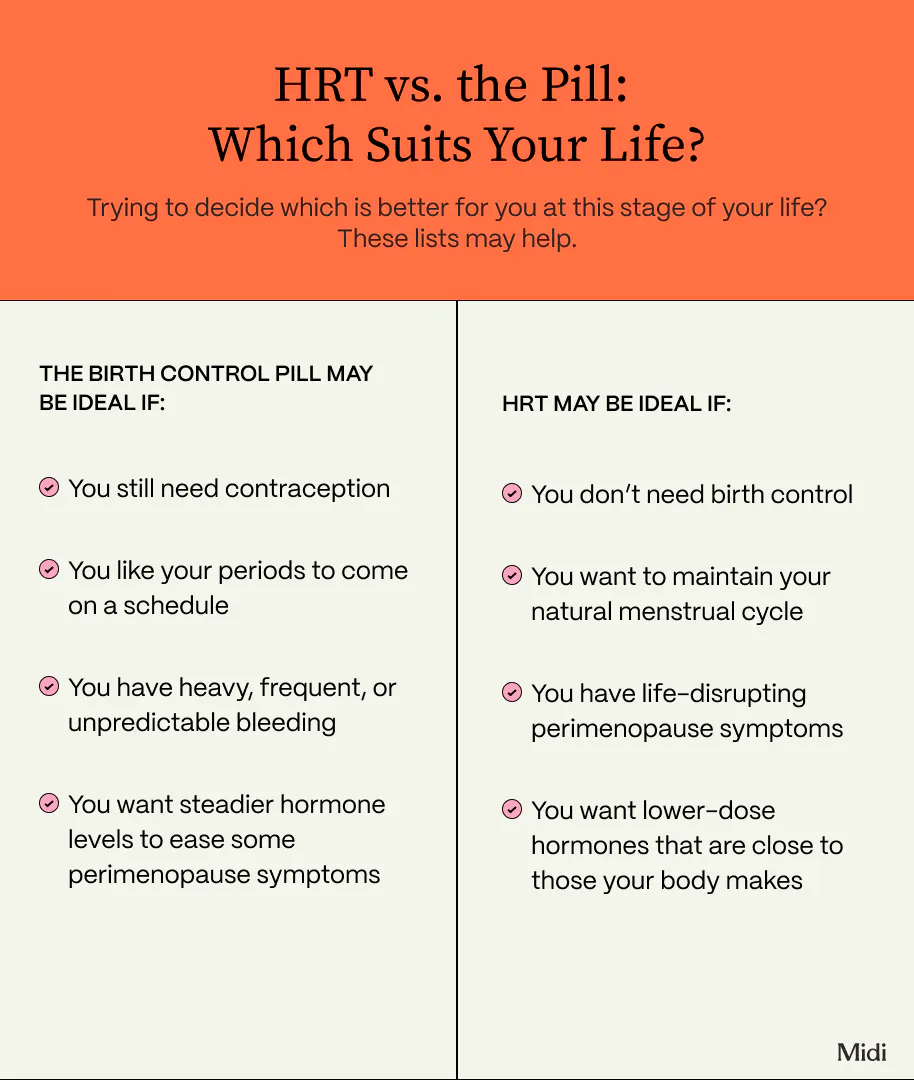
The pill may be a good fit if you’re looking for:
- Reliable contraception
- More predictable periods
- Help with heavy, frequent, or unpredictable bleeding
- Steadier hormone levels to help smooth some of the ups and downs of perimenopause
- Bonus: Hormonal birth control may offer some long-term health perks, including protection against bone loss and a reduced risk of endometrial, colorectal, and ovarian cancers.
That said, the pill isn’t a universal yes for everyone. Your age, smoking status, blood pressure, cardiovascular risk, and other health factors all play a role.
When HRT Might Be the Better Choice
If your main goal is symptom relief—not pregnancy prevention or control of irregular bleeding —HRT may make more sense for you. HRT is designed to replace some of the hormones your body is gradually losing to help manage symptoms like hot flashes, night sweats, sleep disruption, and more.
HRT may be worth considering if you:
- Don’t need contraception and want to focus on feeling better through the menopause transition
- Prefer lower-dose hormones that are similar to the ones your body naturally makes
- Want to let your natural menstrual cycle continue
HRT can offer benefits beyond symptom relief, such as helping prevent bone loss. And in terms of perimenopause HRT and periods, your natural cycle continues. But there’s no universal “best HRT for perimenopause”—the right plan depends on your situation and symptoms. A menopause-informed clinician, like one at Midi, can help you sort through the options.

Safety Information to Know (and Who Should Potentially Avoid Each Treatment)
Like any medication, both the pill and HRT come with potential risks. Because they’re different treatments, they have different safety considerations.
Since birth control pills contain higher doses of hormones, your clinician will consider your health history and risk factors, especially if you:
- Smoke and are over age 35
- Have uncontrolled high blood pressure
- Have a history of blood clots
- Experience certain types of migraines with aura
- Have other cardiovascular risk factors
Because HRT comes in many forms, its risk profile isn’t one-size-fits-all and differs from the pill. Your individual risk depends on factors like your age, health history, when you start treatment, the type of hormones used, and how they’re delivered.
For example, transdermal estrogen (which is estrogen delivered through the skin via a patch, gel, or spray) carries a lower risk of blood clots than oral estrogen. When it comes to breast cancer risk and HRT, the latest research is reassuring: current evidence indicates that HRT does not cause breast cancer. What’s more, starting HRT within 10 years of menopause can decrease the risk of coronary heart disease, preserve bone density to reduce the risk of fractures, and potentially protect against cognitive loss. Because your specific risk depends on your personal health history, a clinician will work closely with you to determine which care solutions are safe and effective for your body.
Your clinician may recommend against HRT or suggest additional evaluation if you have a history of:
- Stroke or certain types of blood clots
- Certain heart conditions, including a history of heart attack or unmanaged high blood pressure
- Certain liver conditions
- Certain types of breast or uterine cancer
- Unexplained vaginal bleeding
Switching From the Pill to HRT, and When to Start
There's no end-all, be-all time to switch from the pill to HRT. Rather, the right time depends on several factors, including your symptoms, health history, risk factors, and whether you still need reliable contraception.
"You don't have to wait until your periods stop to start HRT," says Dr. Hofflich. "The biggest question is contraception and your bleeding pattern. HRT can relieve symptoms, but it doesn't prevent pregnancy, so if you're still ovulating you'll need another reliable form of birth control." And if you’re having heavy or irregular periods, HRT won’t be able to control or fix that.
If you're healthy and don't have certain risk factors, you can often safely stay on the birth control pill until your early 50s. For many women, the pill can be a win-win for managing perimenopause symptoms while also preventing pregnancy. But once contraception is no longer needed—or another birth control method is a better fit—it may be time to consider HRT for continued symptom relief and benefits like supporting bone health.
Ultimately, the decision should be made in consultation with a healthcare professional, like a Midi clinician, who can help you decide if or when it’s time to make the switch and how to do so safely.
How Midi Health Can Help You Decide
Comparing HRT vs. birth control pills for perimenopause can feel like one more thing to add to the midlife juggling act. But you don’t have to navigate it alone.
At Midi, you’ll meet virtually with a clinician who specializes in perimenopause and menopause care. They’ll take a closer look at the full picture to help determine whether the pill, HRT, or another approach makes the most sense for you. (Bonus: Midi is accepted by major insurance plans.)
Because there are many factors to consider, your Care Plan will be personalized to your body and where you are in your menopause journey. Whether you’re feeling overwhelmed or unsure of all your options, a conversation with a Midi clinician can help you feel confident about your next steps.
Key Takeaways
- The birth control pill and HRT both contain hormones, but they’re different treatments. The pill is intended to prevent pregnancy by suppressing ovulation, whereas HRT replaces declining hormones to help relieve menopause symptoms.
- Many women begin HRT during perimenopause if symptoms are affecting their quality of life—but if pregnancy is still possible, you'll need a separate form of contraception.
- The pill can be a great option during perimenopause for some women. It can help regulate unpredictable periods, ease hormone-related symptoms, and provide reliable birth control.
- There isn’t a “best option”—just a best option for you. Your age, symptoms, contraceptive needs, medical history, and personal preferences all help determine whether the pill, HRT, or another treatment makes the most sense.
- A menopause-trained clinician, like one at Midi, can help you understand your options, transition safely between treatments if needed, and create a personalized care plan.
Frequently Asked Questions (FAQs)
Is HRT stronger than the pill?
No, HRT isn’t “stronger” than the birth control pill—it’s different doses and formulations of estrogen and progesterone designed for a different purpose. The hormones in birth control pills are used to stop ovulation, so they’re delivered at a higher dose than the amount of hormones you find in HRT.
Should a 45-year-old woman take birth control pills?
Many healthy women in their 40s can safely use birth control pills, and they can help with both contraception and some perimenopause symptoms. The right choice depends on your health history, risk factors, your bleeding pattern and whether you need pregnancy prevention.
Can you take HRT and birth control at the same time?
HRT and hormonal birth control are not recommended to be taken together because the birth control pill already provides estrogen and progestin at doses that overlap with HRT.
Does the birth control pill mask perimenopause symptoms?
Yes, the pill can mask some signs of perimenopause because it suppresses ovulation and creates more predictable hormone levels. Women who are on the pill often won’t know when they reach menopause.
How do you switch from the pill to HRT in perimenopause?
Switching from the pill to HRT is a personalized decision that depends on your age, symptoms, health history, and need for contraception. Many clinicians recommend transitioning when pregnancy prevention is no longer needed or when HRT becomes a better fit for managing menopause symptoms.
If you’re in perimenopause or menopause and want guidance from clinicians who specialize in women’s midlife health, book a virtual visit with Midi today.
Hormonal change is at the root of dozens of symptoms women experience in the years before and after their period stops.
Our trained menopause specialists can help you connect the dots to guide you towards safe, effective solutions.
Whether you need personalized guidance or a prescription routine to tackle symptoms—including vaginal dryness and irritation, brain fog, hot flashes, sleep trouble, mood swings, and weight gain—we’ve got you covered.
Midi’s mission is to revolutionize healthcare for women at midlife, wherever they live and whatever their health story. We believe that starts with education, to help all of us understand our always-changing bodies and health needs. Our core values guide everything we do, including standards that ensure the quality and trustworthiness of our content and editorial processes. We’re committed to providing information that is up-to-date, accurate, and relies on evidence-based research and peer-reviewed journals. For more details on our editorial process, see here.


