 Heather Hofflich, DO
Estrogen and progesterone come up in a lot of conversations about women’s health. These reproductive hormones have different functions, but they work together in ways that affect much more than your menstrual cycle. As they fluctuate and decline in midlife, they can influence everything from your periods and sleep quality to your mood and overall well-being.
The good news is that you don't have to figure it all out on your own. Understanding the difference between estrogen and progesterone can help you make sense of hormone changes, symptoms, and treatment options during perimenopause and menopause. If you ever have more questions, you can talk with a healthcare professional, such as a Midi Health clinician.
You probably know that hormone changes are behind symptoms like hot flashes, sleep problems, mood changes, and irregular periods. But when it comes to understanding estrogen and progesterone, things can get a little confusing.
Which hormone does what? How do they change during perimenopause and menopause? And why do some women take both hormones while others only take one?
Estrogen and progesterone are key reproductive hormones that help keep your menstrual cycle on track. They also affect everything from bone health and brain function to sleep quality and mood. But they shift significantly in midlife, contributing to many of the changes women notice during the menopause transition.
Although estrogen and progesterone play different roles, they often work together. Understanding what each hormone does can shed light on your symptoms and help you make informed decisions about hormone therapy or other treatment options.
A healthcare professional, like one of Midi's menopause-trained clinicians, can help you navigate your options and find an approach that's right for you.
Estrogen and Progesterone: The Key Difference
Estrogen and progesterone are often talked about as a pair—and for good reason. They’re essential reproductive hormones produced mainly by the ovaries, but they have different jobs. Generally, estrogen takes the lead before ovulation, while progesterone becomes more active afterward.
The easiest way to understand that difference is to look at what happens during a typical menstrual cycle. The first day of your period marks the start of a new cycle, which usually lasts around 28 to 32 days, though cycles can be shorter or longer.
During the first half of the cycle, estrogen levels gradually rise. One of estrogen's primary jobs is rebuilding the lining of the uterus after menstruation and helping an egg mature. Estrogen levels typically peak around ovulation, when one of the ovaries releases an egg.
After ovulation, progesterone levels increase and become the dominant hormone during the second half of the cycle. Progesterone helps prepare and maintain the uterine lining for a possible pregnancy.
If the egg is fertilized, progesterone levels stay elevated to support pregnancy. If pregnancy doesn't occur, estrogen and progesterone levels eventually fall. That drop signals the body to shed the uterine lining, leading to a menstrual period and the start of a new cycle.
Understanding this pattern can make it easier to see how estrogen and progesterone work together while serving different functions throughout the cycle.

What Is Estrogen, and What Does It Do?
Estrogen is actually a group of hormones, including estradiol, that play an important role in women’s sexual and reproductive health. And while it’s best known as a reproductive hormone, estrogen supports several critical processes throughout the body.
Estrogen has many functions, including:
- Supports puberty and reproductive function: Estrogen drives the physical changes that happen during puberty and regulates the menstrual cycle throughout a woman's reproductive years.
- Builds the uterine lining: During the first half of a typical cycle, estrogen helps rebuild the uterine lining after menstruation.
- Helps keep bones strong: Estrogen helps slow natural bone loss, keeping bones healthy and strong. When estrogen declines after menopause, bone loss can happen faster.
- Supports brain function and mood: Research shows that estrogen helps regulate pathways in the brain involved in memory, learning, mood, and stress response.
- Promotes healthy sleep: Estrogen plays a role in several factors, including body temperature and mood, that support restful sleep. This may help explain why sleep problems often become more common as estrogen fluctuates or declines.
- Maintains vaginal and urinary tissue health: Estrogen keeps the tissues in the vagina, vulva, and urinary tract healthy, elastic, and lubricated. When levels fall, these tissues can thin and dry out, causing pain or irritation.
Because estrogen affects so many different parts of the body, it's no wonder fluctuating levels can contribute to a wide range of symptoms in midlife, especially during perimenopause and menopause.
What Is Progesterone, and What Does Progesterone Do for Women?
Progesterone might get less attention than estrogen in conversations about women’s health, but it’s just as important. This reproductive hormone plays a key role in the menstrual cycle and pregnancy.
Here’s a closer look at what progesterone does for women.
- Supports the menstrual cycle: Progesterone levels rise after an egg is released during ovulation. It becomes the main hormone during the luteal phase, or second half, of the menstrual cycle.
- Prepares the uterus for pregnancy: After estrogen builds up the uterine lining, progesterone steps in to stabilize it and prepare it for a possible pregnancy.
- Supports pregnancy: If conception occurs, progesterone stays elevated to help maintain the pregnancy and support early fetal development.
- Regulates menstrual cycle bleeding: After ovulation, progesterone helps keep the uterine lining in place and prevents it from becoming too thick. If pregnancy doesn't happen, progesterone levels drop, triggering a new menstrual period. Without enough progesterone, the uterine lining may continue to build up, which can lead to irregular or heavier periods.
Although progesterone’s main job is to support the menstrual cycle and pregnancy, research suggests that it may also affect the brain and immune system. As levels become less predictable during perimenopause, these changes can affect menstrual cycles and other symptoms that women experience in midlife.
What Success Looks and Feels Like
How Estrogen and Progesterone Work Together
Estrogen and progesterone have different jobs, but they don't work independently. Throughout the menstrual cycle, they rise and fall in a coordinated pattern to help keep everything on track. Instead of estrogen vs. progesterone, think of them as teammates with different roles.
Estrogen increases in the first half of the cycle to help the uterine lining grow, while progesterone rises in the second half to help keep that growth in check and prepare the body for a possible pregnancy.
Together, estrogen and progesterone help regulate the menstrual cycle, coordinate ovulation, and support reproductive health. So it's not always about having too much or too little of either hormone. Sometimes it's the timing, fluctuations, and balance between the two that matter most.
When that balance starts to shift—as it usually does during perimenopause—irregular periods, heavy bleeding, and other symptoms may show up.
How These Hormones Change in Perimenopause and Menopause
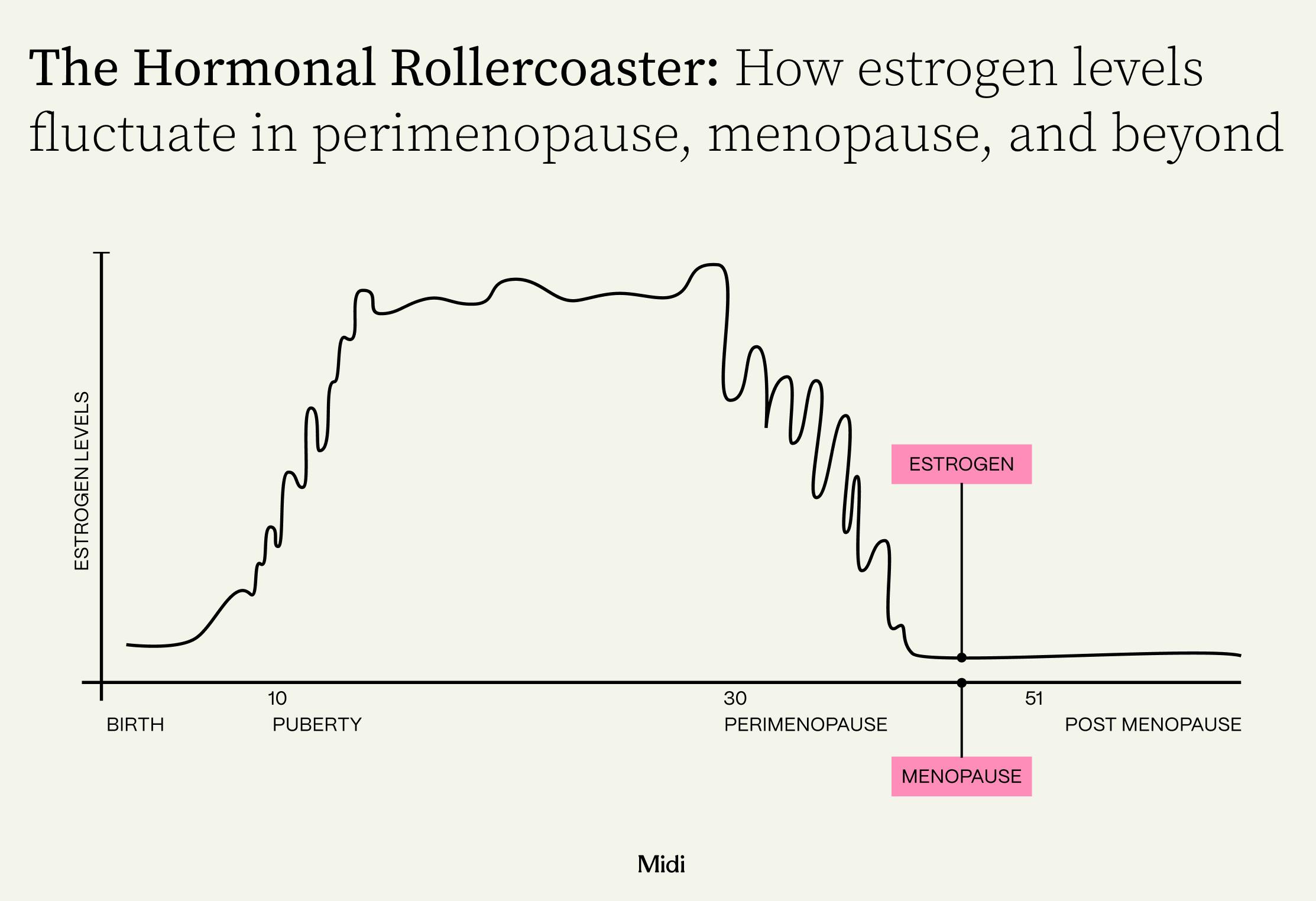
Perimenopause is where things can get interesting—and let's be honest—a little confusing. During this transition phase in the years before menopause, fluctuating hormones can take you on a wild ride.
As you move through your 40s toward menopause, ovulation becomes less predictable. One month, everything follows a typical pattern. The next, ovulation happens later than usual or not at all. And when ovulation is less consistent, progesterone levels may shift, too. That's one reason why irregular periods are often an early sign of perimenopause.
At the same time, estrogen levels may swing higher or lower than usual throughout the menopausal transition. These ongoing shifts in estrogen and progesterone can affect everything from your period to your body temperature to your sleep quality. They also help explain why symptoms might come and go or change from one month to the next.
While estrogen and progesterone eventually settle at much lower levels after menopause—defined as going 12 consecutive months without a period—the years leading up to it can be especially unpredictable.
Understanding these changes can make it easier to connect the dots between fluctuating hormones and the symptoms that often accompany them during the menopausal transition.
Symptoms People May Notice When Hormone Levels Change
As estrogen and progesterone fluctuate during perimenopause, many women start noticing changes in how they feel day to day. These shifts affect everyone differently, but some symptoms are more common than others, including:
- Irregular periods: Your cycles may be longer or shorter than usual, and your periods may be heavier, lighter, or less consistent.
- Hot flashes and night sweats: Changing estrogen levels can affect how your body regulates temperature, causing hot flashes. In fact, nearly 8 out of 10 women experience hot flashes and night sweats during the menopause transition.
- Mood changes or irritability: Mood changes can leave many women feeling more irritable, angry, or anxious than usual.
- Sleep problems and fatigue: Between disruptive night sweats and other physical changes, it's not surprising that sleep problems and fatigue are common complaints for women in midlife.
- Vaginal dryness or discomfort with sex: Declining estrogen can change vaginal tissue, leading to symptoms like vaginal dryness, irritation, or pain during sex.
- Brain fog, headaches, or bloating: As hormones shift, some women also notice brain fog or trouble concentrating, headaches, or bloating.
Why the Difference Matters for Hormone Therapy
Understanding the difference between estrogen and progesterone can help you make sense of your symptoms and the treatment options that might help you manage them.
Hormone replacement therapy (HRT) is considered the most effective treatment for common menopause symptoms, such as hot flashes, night sweats, and vaginal dryness. It works by restoring some of the hormones that naturally decline during menopause. Estrogen is usually the primary hormone used to treat symptoms.
But hormone therapy isn't one-size-fits-all. For example, if you still have a uterus, estrogen is usually prescribed alongside progesterone to help protect the uterine lining. If you've had a hysterectomy, estrogen-only therapy may be a suitable option.
HRT can be prescribed in several forms, including pills, patches, gels, sprays, and vaginal rings. So the right approach depends on your symptoms, health history, personal preferences, and other individual factors. You should always work closely with your healthcare professional, like a Midi clinician, to find out what is right for you.
How Clinicians Decide What Treatment Makes Sense
There’s no universal approach to menopause treatment. But a healthcare professional, like one of Midi’s menopause-trained clinicians, can help you sort through your options.
The conversation usually starts with a closer look at what you’ve been experiencing. A healthcare professional may ask about everything from your mood and sleep quality to hot flashes or period changes. From there, they can help determine whether your symptoms are related to menopausal hormone shifts, another health concern, or a combination of factors.
Finding the right treatment is a team effort. You can share your preferences, ask questions, and weigh potential benefits and risks of different options. Together, you can decide on an approach that feels right for you. And because symptoms and health needs may change over time, your healthcare professional can adjust your treatment plan along the way.
Menopause care looks at the whole picture, not just a single symptom or hormone. The best treatment plan is the one that addresses your symptoms, fits your health history, and aligns with your goals and preferences.

When to Talk With a Healthcare Professional
Some hormone changes are expected in midlife, but that doesn't mean you have to navigate them alone or wait until symptoms become disruptive to ask for help.
Talk with a healthcare professional if you have:
- symptoms that interfere with your daily life, relationships, or sleep
- heavy bleeding or rapidly changing menstrual cycles
- any bleeding after menopause
- new vaginal dryness, painful sex, or urinary symptoms
- frequent hot flashes or night sweats
- questions about whether hormone therapy is appropriate for you
Early support can make it easier to understand what's happening and explore treatment options.
Key Takeaways
- Estrogen and progesterone are reproductive hormones that help regulate the menstrual cycle, but they have different jobs. Estrogen helps build the uterine lining before ovulation, while progesterone helps stabilize it afterward and prepare the body for a possible pregnancy.
- Estrogen plays an important role beyond reproduction. It helps support strong bones, brain function, sleep quality, mood, and vaginal and urinary health.
- During perimenopause, estrogen and progesterone often fluctuate as they decline. Common symptoms like irregular periods, hot flashes, sleep problems, and vaginal dryness are often linked to changes in estrogen, progesterone, or both.
- HRT is considered the most effective treatment for common menopause symptoms, but the right approach depends on your symptoms, health history, and goals. For women with a uterus, HRT often includes both estrogen and progesterone, while estrogen-only therapy may be an option after a hysterectomy.
Frequently Asked Questions (FAQs)
What is the difference between estrogen and progesterone?
Estrogen and progesterone are reproductive hormones produced mainly by the ovaries. They work together to regulate the menstrual cycle, but have different jobs. Estrogen helps build the uterine lining before ovulation, while progesterone helps maintain it afterward and prepare the body for a possible pregnancy.
What are estrogen and progesterone in simple terms?
Estrogen and progesterone are essential reproductive hormones in women. They help drive physical changes in puberty, regulate the menstrual cycle, and support pregnancy.
What does progesterone do for women?
Progesterone is a reproductive hormone that helps regulate the menstrual cycle, prepare the uterus for pregnancy, and support early pregnancy. During the second half of the menstrual cycle, it helps keep the uterine lining in place until the next period or pregnancy occurs.
Is estrogen more important than progesterone?
No. Estrogen and progesterone are both important reproductive hormones, but they have different roles. Rather than thinking of one hormone as more important than the other, it's more accurate to think of them as partners that work together to support the menstrual cycle, pregnancy, and overall health.
Do estrogen and progesterone both drop in menopause?
Yes. Estrogen and progesterone often fluctuate before eventually declining. After menopause—when you've gone 12 months without a period—both hormones stay at much lower levels than they were during the reproductive years.
Do I need both estrogen and progesterone in menopause treatment?
It depends. If you still have a uterus, hormone replacement therapy is usually prescribed with estrogen alongside progesterone to help protect the uterine lining. If you've had a hysterectomy, estrogen-only therapy may be an option. The right approach depends on your symptoms, health history, and treatment goals.
If you’re in perimenopause or menopause and want guidance from clinicians who specialize in women’s midlife health, book a virtual visit with Midi today.
Hormonal change is at the root of dozens of symptoms women experience in the years before and after their period stops.
Our trained menopause specialists can help you connect the dots to guide you towards safe, effective solutions.
Whether you need personalized guidance or a prescription routine to tackle symptoms—including vaginal dryness and irritation, brain fog, hot flashes, sleep trouble, mood swings, and weight gain—we’ve got you covered.
Midi’s mission is to revolutionize healthcare for women at midlife, wherever they live and whatever their health story. We believe that starts with education, to help all of us understand our always-changing bodies and health needs. Our core values guide everything we do, including standards that ensure the quality and trustworthiness of our content and editorial processes. We’re committed to providing information that is up-to-date, accurate, and relies on evidence-based research and peer-reviewed journals. For more details on our editorial process, see here.