
 Rebecca Yee, MD
If you’re experiencing the intense itching and burning of a yeast infection, it’s no surprise if you’re wondering just how long a yeast infection lasts (and when you may finally feel better). Generally, yeast infections last 3 to 7 days, but that timeframe can vary depending on how severe the infection is, how you treat it, and how quickly you start that treatment. Learn more below, including what to do when symptoms don’t ease as quickly as you expect and how a Midi Health clinician can help during this itchy, ouchy time.
Oh, that familiar itchy burn of a yeast infection that makes you shift in your seat to ease the discomfort, as you try to remember, How long does a yeast infection last? How long do I need to put up with this?
With treatment, the annoying symptoms of a mild yeast infection will start to improve within a few days, and the infection should clear up in about 3 to 7 days. But an untreated yeast infection can linger for weeks, and the discomfort will only get worse.
When you’re in the middle of dealing with the burning itchiness, you (of course) want relief as quickly as possible. While many yeast infections tend to respond pretty quickly to treatment, the timeline for recovery depends on how severe the infection is; the treatment you use; and underlying factors like recent antibiotic use, immune health, pregnancy, and hormonal changes during perimenopause and menopause.
Below, we’ll give you the info you need to escape the discomfort, including more on the timeline of how long yeast infections last, what factors affect recovery time, why some infections won't go away, and when and how a clinician (like one at Midi) can help.
How Long Does a Yeast Infection Last?
Most mild vaginal yeast infections start to get better within a few days of starting treatment and typically clear up within about 3 to 7 days. When the infection is more severe or complicated, it can take up to 2 weeks or longer to fully resolve.
Here's a general timeline of what to expect:
- Days 1 to 3: If you're using an antifungal treatment, symptoms such as itching, burning, and irritation often begin to improve. Even if symptoms start to improve quickly, though, it's important to finish the full course of treatment as directed.
- Days 3 to 7: Most uncomplicated yeast infections continue improving or have resolved by the end of treatment.
- Week 2+: If your symptoms haven't improved, get worse, or return soon after treatment, contact your clinician. You may need a different approach, or you may have a complicated yeast infection or even a different condition that’s causing your symptoms.
Recovery isn't the same for everyone. A more severe infection can take longer to get over, and other factors can affect how quickly you improve: the type of treatment you use, your overall health, and whether it's your first yeast infection or a recurring one.
Wait, What Is a Yeast Infection, Again?
A vaginal yeast infection is a common fungal infection caused by an overgrowth of Candida (usually Candida albicans), a type of yeast that naturally lives in the vagina. It’s usually kept in balance by healthy bacteria and the body's immune system. When that balance is disrupted, yeast can multiply.
Common yeast infection symptoms include:
- intense vaginal or vulvar itching
- burning or irritation, especially when urinating or during sex
- redness or swelling of the vulva
- thick, white vaginal discharge, often with a cottage cheese-like appearance
Yeast infections are extremely common. About 75% of women will experience at least one at some point in their life, and many will have more than one episode. While yeast infections can be uncomfortable, they’re usually not serious and typically respond well to antifungal treatment.
How Long Does a Yeast Infection Last With Treatment?
The itching and burning of a yeast infection usually starts to improve with antifungal medication within 1 to 3 days. But it often takes about a week for symptoms to fully resolve.
There are several types of yeast infection medications, including:
- Prescription oral fluconazole (Diflucan): Many uncomplicated yeast infections can be treated with a single oral dose. Symptoms often continue improving over the next several days and typically resolve within about a week. For more moderate or severe infections, your clinician may prescribe a second dose to be taken 72 hours later, or a longer course of treatment.
- Over-the-counter (OTC) antifungal creams and suppositories: These are available in 1-day, 3-day, and 7-day treatment courses. All can be effective when used as directed, but longer courses may be recommended for some people, depending on how severe the infection is. (Here’s a get-real note about 1-day treatments: That “1-day” refers to how long you use the medication—it doesn’t mean your symptoms will disappear that quickly.)
If you’ve been searching for info on how to get rid of a yeast infection in 24 hours, keep in mind that no treatment works instantly. Even if the medication starts easing your symptoms within a day or two, your body still needs time to clear the infection.
If your symptoms get worse or return soon after treatment, talk with your clinician. You may need a different medication or evaluation for another condition that can mimic a yeast infection.
Stories of Success
Do Yeast Infections Go Away on Their Own?
Some medical experts say a mild yeast infection may occasionally resolve without treatment, but most say that an untreated yeast infection can continue to cause uncomfortable symptoms or become more severe over time.
Generally, it makes the most sense to go ahead and treat a yeast infection, because that’s a quicker way to get rid of the burning, itching, and irritation (and do you really want to take the chance that these symptoms will get worse?).
There are other reasons not to wait. For one thing, it’s hard to avoid scratching the itch—and if you scratch enough, you may damage the delicate skin around the vulva, making it more vulnerable to infection.
Plus, if you try to “wait out” the infection, you put off finding out whether you really have a yeast infection or a different condition, such as bacterial vaginosis (BV) or a urinary tract infection (UTI), that has some overlapping symptoms and would need a different treatment altogether.

Which Factors Affect How Long a Yeast Infection Lasts?
How long a yeast infection will stick around depends on a few factors, including:
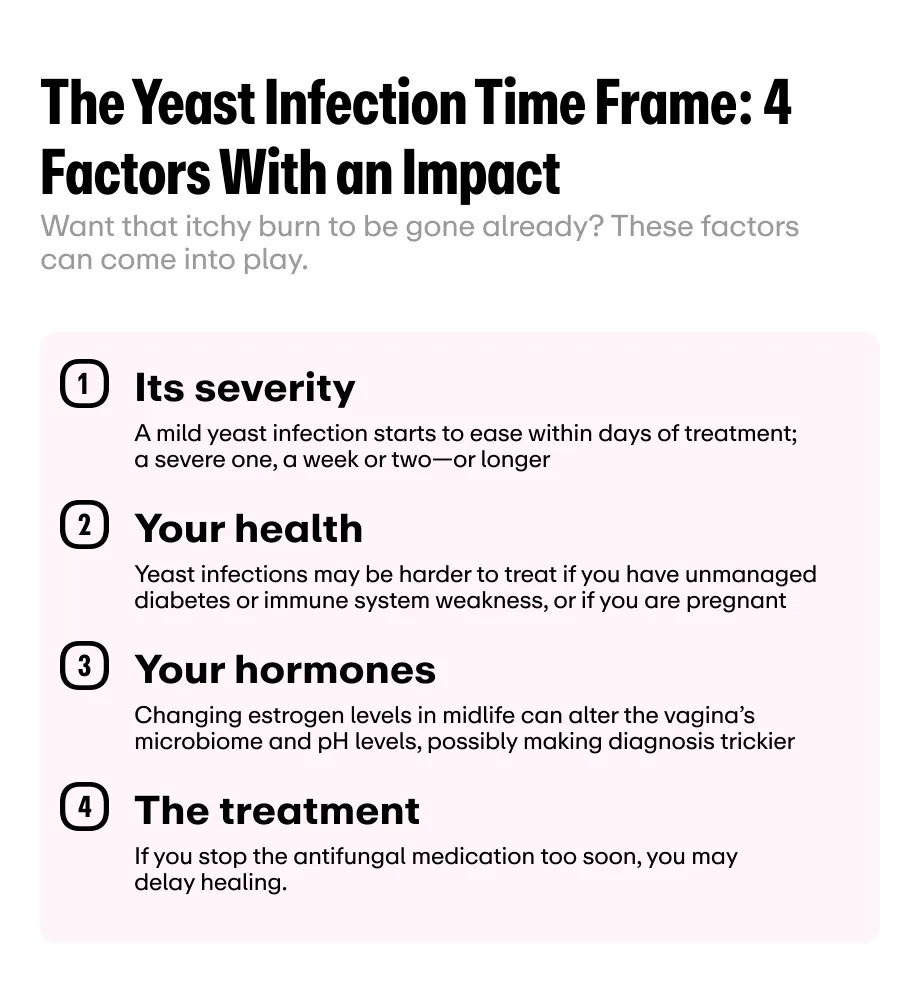
- Severity of the infection: More severe infections may take 1 to 2 weeks or longer to fully resolve. Infections caused by certain types of yeast, such as Candida glabrata, may take longer to treat. Plus, some initial treatments fail due to antifungal resistance. If this happens—or if you've had yeast infections before or experience recurrent infections—your clinician may also recommend a longer course of treatment.
- Your overall health: Certain health issues can make yeast infections harder to treat or more likely to recur. These include unmanaged diabetes, a weakened immune system, recent antibiotic use, and pregnancy, all of which can make yeast overgrowth more likely. Those who are on corticosteroids are also at higher risk, since steroids can affect the immune system.
- Hormonal changes: Fluctuating and declining estrogen levels can alter the vagina’s microbiome and pH levels, which ups the risk of some vaginal infections and sometimes makes diagnosis harder.
- How the infection is treated: The healing may be delayed if you stop antifungal medication too soon, use the wrong medication (when, say, the symptoms are caused by another condition), or use irritating products such as scented soaps or douches. And if you wear tight, non-breathable clothing that traps heat and moisture, it may just irritate the area more.
Why Won't My Yeast Infection Go Away?
When a yeast infection won't go away and is lingering despite treatment, several possible reasons could be at play:
- A different condition is causing your symptoms: BV, urinary tract infections (UTIs), and certain skin conditions can mimic some yeast infection symptoms.
- The particular yeast isn't responding to treatment: While most infections are caused by Candida albicans, other Candida species may require different medications.
- The infection has come back: Underlying factors such as antibiotic use, unmanaged diabetes, or hormonal changes can increase the risk of recurrent infections.
If you seem to keep getting yeast infections, this may be recurrent vulvovaginal candidiasis, which is generally defined as 3 or more symptomatic yeast infections in a year. Recurrent infections often need a longer course of treatment, as well as an evaluation to identify contributing factors.
If your symptoms aren't easing after treatment or keep returning, it’s time to consult your clinician. They may order tests to determine whether it’s actually a yeast infection or if another condition could be behind your symptoms.
How Do Menopause and Hormones Affect Yeast Infections?
Hormonal changes during perimenopause and menopause can affect vaginal health in ways that may increase the risk of infections. As estrogen levels decline:
- Vaginal pH rises
- The balance of healthy bacteria in the vagina changes
- Vaginal tissues become thinner and drier
Together, these changes can increase the risk of a yeast infection. However, after you reach menopause, yeast infections become less common (unless you are actively taking estrogen therapy).
But this life stage can also make symptoms more confusing. Vaginal itching in menopause isn't always caused by a yeast infection.
Vaginal dryness and genitourinary syndrome of menopause (GSM) can also cause itching, burning, irritation, and discomfort during sex or urination—symptoms that can closely resemble a yeast infection. That's why it's important not to assume vaginal irritation is caused by yeast, especially if OTC antifungal medications aren't helping.
If declining estrogen is contributing to your symptoms, part of the solution may be treating the underlying hormonal changes.
Depending on your symptoms and medical history, your clinician may recommend hormone therapy or low-dose vaginal estrogen to help restore the vaginal tissues and support a healthier vaginal environment. These treatments aren't used to treat an active yeast infection, but they may help improve vaginal health and reduce symptoms related to estrogen loss.
If you're experiencing recurrent vaginal symptoms during midlife—or you're unsure whether you have a yeast infection or another condition—it's worth consulting a clinician who’s menopause-informed, like one at Midi. Getting the right diagnosis is the first step toward finding the most effective treatment.

When Should You See a Clinician for a Yeast Infection?
While mild yeast infections may improve with OTC treatment, some symptoms definitely warrant a consultation with a healthcare professional:
- Your symptoms last longer than 1 to 2 weeks
- You don't notice any improvement after a course of treatment
- You have recurrent yeast infections (multiple infections in a year)
- You develop fever, pelvic pain, or foul-smelling vaginal discharge, which may indicate a different or more serious condition
- This is your first yeast infection, or you're unsure if that’s actually what you have
A Midi clinician will ask about your symptoms and medical history, help determine whether hormonal changes are involved, and prescribe medications if needed. They may refer you for a pelvic exam, vaginal pH testing, or a culture to identify the specific Candida species if your symptoms are persistent or keep coming back. If needed for resistant or recurrent infections, they can prescribe a different antifungal medication or a longer course of treatment.
Key Takeaways
- Most mild yeast infections improve within 3 to 7 days with treatment, while more severe or complicated infections may take 1 to 2 weeks or longer to fully resolve.
- Symptoms should start improving within 1 to 3 days of beginning treatment, but it’s important to complete the full treatment of medication even if symptoms ease.
- Don't assume every episode of vaginal itching or burning is a yeast infection. Bacterial vaginosis (BV), genitourinary syndrome of menopause (GSM), and other conditions can cause similar symptoms.
- If your symptoms don't improve or keep coming back, or you're experiencing recurrent yeast infections, consult your clinician for an accurate diagnosis and the right treatment.
- Hormonal changes during perimenopause and menopause can affect vaginal health and may contribute to recurring symptoms, making it especially important to identify the underlying cause.
Frequently Asked Questions (FAQs)
How do I know if my yeast infection is going away?
One of the first signs that a yeast infection is improving is that itching, burning, and irritation begin to lessen. Many people notice some relief within 1 to 3 days of starting treatment, although it can take up to a week or longer for the infection to fully clear.
How do you flush yeast out of your system?
You can't "flush" a yeast infection out of your system. Vaginal yeast infections are treated with antifungal medications, which stop the overgrowth of yeast. Douching (never a good idea for your vaginal health) or trying home remedies won't cure a yeast infection and may make symptoms worse.
What are the stages of a yeast infection?
A yeast infection often begins with mild itching or irritation, followed by increased burning, more intense itching, redness, swelling, and sometimes a thick white discharge. With appropriate treatment, symptoms usually begin to ease within a few days and gradually resolve over the following week.
What worsens a yeast infection?
Untreated yeast infections can become more uncomfortable over time. Scratching or using scented soaps or douches may also make symptoms worse or delay healing.
What does a yeast infection feel like?
A vaginal yeast infection commonly causes intense itching, burning, and irritation around the vulva and vagina. Many people also see redness and swelling, as well as a thick, white discharge that resembles cottage cheese, although discharge isn't always present.
If you’re in perimenopause or menopause and want guidance from clinicians who specialize in women’s midlife health, book a virtual visit with Midi today.
Hormonal change is at the root of dozens of symptoms women experience in the years before and after their period stops.
Our trained menopause specialists can help you connect the dots to guide you towards safe, effective solutions.
Whether you need personalized guidance or a prescription routine to tackle symptoms—including vaginal dryness and irritation, brain fog, hot flashes, sleep trouble, mood swings, and weight gain—we’ve got you covered.
Midi’s mission is to revolutionize healthcare for women at midlife, wherever they live and whatever their health story. We believe that starts with education, to help all of us understand our always-changing bodies and health needs. Our core values guide everything we do, including standards that ensure the quality and trustworthiness of our content and editorial processes. We’re committed to providing information that is up-to-date, accurate, and relies on evidence-based research and peer-reviewed journals. For more details on our editorial process, see here.