
When you’re dealing with disruptive, sweaty nights of less-than-ideal rest, the idea that essential oils for sleep could ease you into a sweet-scented slumber is very appealing. It’s true that aromatherapy could help you create a serene, calming bedtime routine, and that certain essential oils, especially lavender, have science behind them as potential sleep supporters. They’re not a substitute for help from a trained healthcare professional (like a Midi Health clinician) if sleep problems are interfering in your day-to-day life. But we’ve got info on the best essential oils for sleep, how to choose and use them safely, and more.
In menopause, there are few greater gifts than a full night’s sleep. And there are so many ideas on how to achieve the best possible slumber, including using essential oils for sleep. Aromatherapy feels relaxing and smells good, and depending on the scent, you might even get some help moving you toward dreamland.
There’s some meaningful research showing that lavender in particular may help improve sleep quality, and other oils may have promising evidence as well. That said, the improvements won’t be dramatic. So, while essential oils for sleep can be one potential tool on your quest for better rest, don’t think of them as the be-all-end-all solution, either.
Keep reading for a breakdown of the five essential oils worth considering, the best ways to use them, and need-to-know safety information. Plus, learn when it’s important to look beyond aromatherapy and how Midi clinicians can help you find care for persistent sleep struggles.
How Do Essential Oils Affect Sleep?
Certain essential oils may be a worthwhile natural sleep remedy to try. That’s because, biologically speaking, smell and sleep are closely related. Researchers think scent may affect sleep through direct connections between brain regions that control smell and sleep, as well as by changing alertness and breathing. Scent may also influence how quickly you fall asleep and how well you sleep.
Plus, if you use it regularly, aromatherapy can become a useful sleep ritual that supports a nightly wind down. Just like a consistent bedtime gets your body into a routine, the ritual of essential oils can condition your body that it’s time to sleep.
If essential oils help you sleep, the benefits may be due in part to the placebo effect, but those benefits can still be helpful. Though aromatherapy isn’t a treatment for a serious sleep issue like insomnia, it can be a useful—and enjoyably soothing—part of what helps you get ready for rest.
If you’re interested in trying aromatherapy for sleep, it’s important to know the best essential oils to consider.
Lavender: The Only Oil With Real Research Behind It
Lavender is the best-studied essential oil for sleep. The active natural compounds in lavender are linalool and linalyl acetate. Animal studies have found that linalool may trigger calming signals in the brain, while linalyl acetate may contribute to linalool’s calming impact.
A number of studies have shown the impact of lavender on sleep. For instance, a 2025 meta-analysis looked at 11 studies on the topic, involving a total of 628 adults. Overall, it found that lavender essential oil had a small but statistically significant sleep-enhancing effect—but the researchers said that more high-quality research is warranted.
Look for a high-quality lavender oil, since many products out there are blends of cheaper oils. Check out the label for Lavandula angustifolia (not just the word “lavender”), and stay away from products that use lavandin, an inexpensive hybrid that has a sharp medicinal scent.
Lavender oil won’t ease night sweats or help chronic insomnia—talk with a healthcare professional about those issues—but for many women, it could help ease you into deeper Zzzzs.
4 More Essential Oils Worth Trying
Lavender may have the most data behind when it comes to sleep, but here are four other essential oils worth considering, based on small studies:
- Chamomile: A 2024 study review looked at 10 studies involving over 700 people and found evidence that this essential oil helped some people fall asleep faster and awaken less during the night. (The researchers noted that more uniform studies are needed.)
- Bergamot: A small study on students showed some promising results: Using bergamot essential oil before bed helped them sleep longer and feel less sleepy when they woke up. It also helped reduce anxiety and stress.
- Bitter orange/Neroli (Citrus aurantium): A study on 80 postmenopausal women who experienced sleep disruptions found that this essential significantly boosted their sleep quality.
- Marjoram: The sleep power of this essential oil seems to be when it’s used as part of a blend. For instance, one study showed that when marjoram was added to lavender oil, the blend was better at improving sleep than lavender on its own.
How to Use Essential Oils for Sleep
There are a few different ways to use essential oils for sleep:
- Diffusion: Use 3 to 5 drops per 100 milliliter (mL) of water, or use fewer drops if you’re more sensitive or just starting off. Run the oil diffuser near you for 30 to 60 minutes before bedtime.
- Pillow and linen spray: If you’re making your own spray, add about 15 drops of oil (lavender only or a combination) to 1 cup of water. You’ll want to add about 2 tablespoons of witch hazel, rubbing alcohol, or vodka to help the oil and water mix. You can also put a few drops on a cotton ball under your pillow.
- Topical application: You should never apply essential oils directly to the skin without diluting them first. They generally need to be added to a carrier oil like jojoba, fractionated coconut, or sweet almond oil. Look up the best amount of whatever specific essential oil and carrier oil you’re using, and always do a patch test before application.
- Bath use: Mix 5 to 10 drops of essential oil into a carrier oil, or mix into Epsom salt.
Many of the studies on how to use lavender oil for sleep use it via diffusion, inhalation, or pillow spray.
True Stories Of Transformation
Building an Evening Routine Around Aromatherapy
If you’re going to make aromatherapy part of your evening routine, it’s best to do it regularly. Consistency can help reinforce sleep cues; with aromatherapy, the scent of the essential oil becomes the signal that it’s time to wind down for bed.
Pairing aromatherapy with good sleep hygiene—a cool temperature in your bedroom, a consistent wake time, no screens before bed—may well lead to better overall sleep.
If you are going to add essential oils to your sleep routine, give it 2 to 3 weeks to see whether it’s having an impact. It may also help to switch up the scents you use every once in a while.
Safety Tips
Essential oils can be very safe if used correctly, but they do carry some risks. Most essential oils are not designed to be ingested, and it’s never advised to do so unless directed by a qualified clinician. Other safety tips to keep in mind:
- Always dilute the oil before applying it to the skin.
- Do a patch test first to avoid potential reactions.
- Keep essential oils away from pets, especially cats, which are biologically very sensitive to some of the compounds in essential oils.
- Also keep essential oils away from anyone with asthma and allergies, pregnant people, and small children.
- Some citrus oils, including bergamot, can cause phototoxicity, a severe skin reaction caused by UV light. If applying to your skin, it’s best to wait 12 to 18 hours after application to be in the sun.
- It’s not recommended to run a diffuser of essential oils continuously overnight—it can irritate the airways, and in some people can irritate the eyes or cause headaches or dizziness. Run it for only a limited time before bed.
Do Essential Oils Help With Hot Flashes and Night Sweats?
As convenient as it would be to have an essential oil that helps manage hot flashes and night sweats, the data on the subject is extremely limited. Lavender may help calm the anxiety and stress connected with vasomotor symptoms, but it doesn’t treat the underlying cause. To target the actual physiology of hot flashes, hormone replacement therapy (HRT, now commonly referred to as menopause hormone therapy, or MHT) is generally the most effective care solution. If you can’t or don’t want to try HRT, however, several non-hormonal treatments may help as well.
That said, if you find that breathing in a calming scent eases your stress somewhat, it may give you some relief, even if it can’t stop the hot flashes from occurring. And a cool lavender mist might be really comforting when your body starts to overheat.

How to Choose Quality Essential Oils
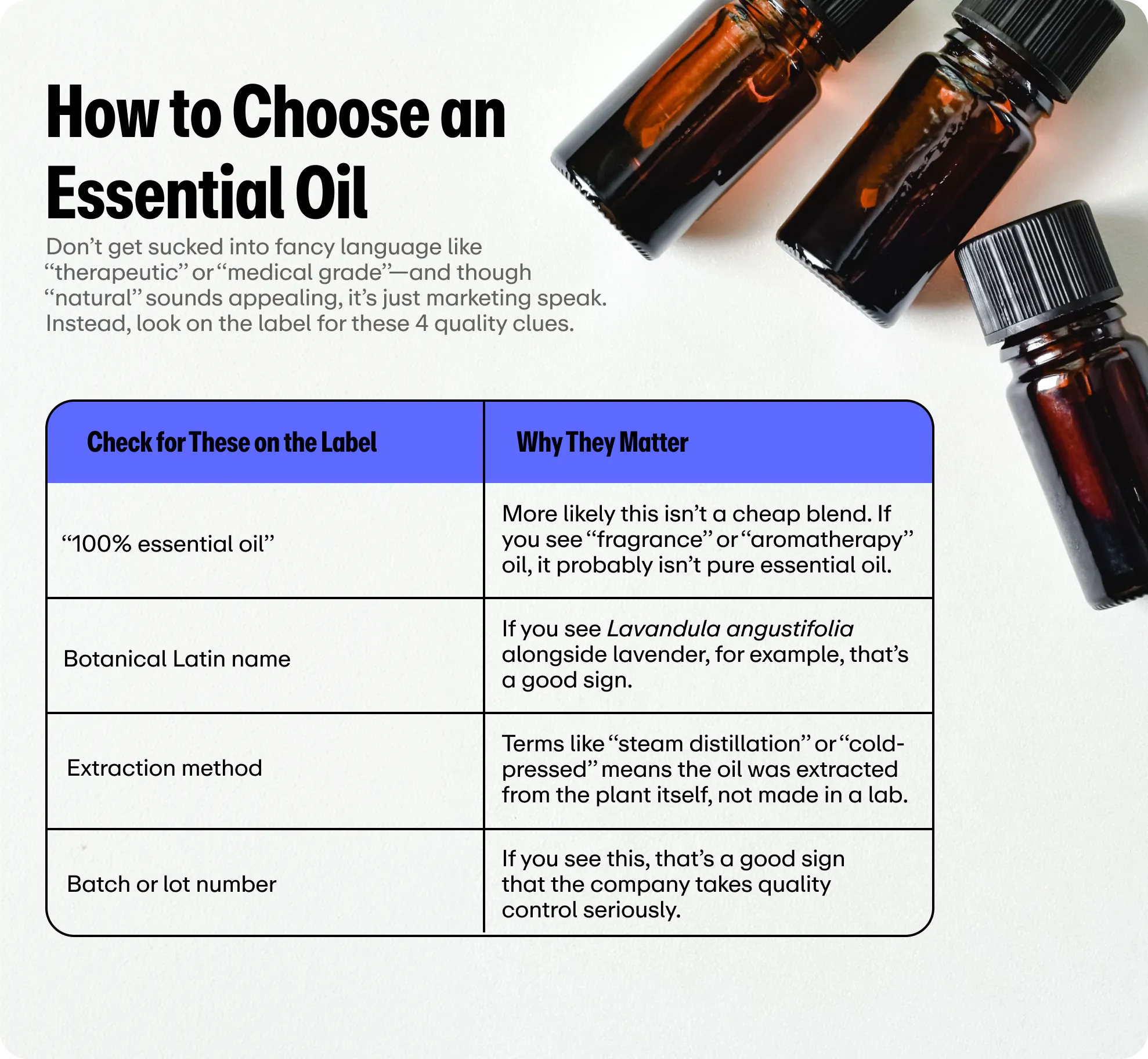
In the wild world of essential oils, there’s little regulation and a ton of marketing language—like “therapeutic,” “medical grade,” and “natural”—which don’t indicate anything about quality. You’ll want to look for the following indicators to choose the best essential oils for menopause or sleep:
- Botanical Latin name: Alongside a familiar name like lavender, you should see a term like Lavandula angustifolia, for example.
- Extraction method: The most high-quality type is where the oil was extracted from the plant (for example, via steam distillation or cold pressing) and not synthetically made in a lab.
- 100% essential oil: If the bottle says “fragrance oil” or “aromatherapy oil,” it probably isn’t a pure essential oil. Yes, those will be less expensive, but you won’t get the same quality.
- Batch or lot number: When a company includes the batch testing and gas chromatography reports, that can help you understand the purity, consistency, and quality of the oil.
- Proper storage bottle: That’s generally a darker glass bottle. You can expect citrus oils to last around 1 or 2 years, and lavender and other botanicals 2 to 3 years.
When to Look Beyond Aromatherapy
Aromatherapy is a nice add-on to a sleep routine, but if sleep problems are persisting beyond a few weeks or causing daytime drowsiness, talk with your clinician. Some issues to discuss:
- Menopause symptoms: Symptoms like night sweats generally have a hormonal cause, and there are treatments that can help.
- Sleep apnea: Sleep apnea is often overlooked in women because the signs are more subtle than men: low energy, fatigue, and headaches, not necessarily loud snoring. Your clinician can discuss solutions with you.
- Mental health concerns: Anxiety and depression can also disrupt sleep; targeted treatments can help with those mental health issues and the sleep problems they cause.
If you’re interested in supplements, consider Midi’s Nightly Steady Sleep+, a supplement powder designed to deal with the hormonal reality of 3 a.m. sweaty sleep disruptions, when your body suddenly moves into high alert. It contains glycine to help lower your body’s core temperature, magnesium glycinate to slow down your racing thoughts, myo-inositol to move you gently toward calm, and zinc to support a steadier night’s sleep.
If you’re concerned about your sleep issues and natural remedies haven’t had much of an impact, a Midi clinician can help you get to the root of your problem and guide you to relief that’s based on your individualized needs.

Key Takeaways
- Aromatherapy is a nice addition to a before-bed sleep routine, and some essential oils may have benefits, but much of the data is limited.
- Lavender essential oil has the most scientific support connected to improving sleep.
- The essential oils market isn’t regulated, so read labels and look for 100% essential oils, rather than those marketed as “fragrance oil” or “aromatherapy oil.”
- If you’re having major disruptive sleep issues like night sweats, sleep apnea, or insomnia—or you find that daytime sleepiness is having an impact on your life—it’s best to consult a clinician.
Frequently Asked Questions (FAQs)
What is the strongest essential oil for sleep?
The essential oil that has the strongest evidence for sleep is lavender; a number of studies back up the claim that it can help with sleep.
What essential oil makes you fall asleep quicker?
Essential oils can create a relaxing environment to promote better sleep. Lavender is often cited as one of the best essential oils for sleep. When it comes to helping you fall asleep faster, though, simply using aromatherapy as part of a wind-down routine can help set cues and a routine that can set you up for better nights.
What is the best oil for sleep and anxiety?
Lavender essential oil has the most data to support its benefit for sleep and anxiety. It won’t resolve serious issues like insomnia or chronic anxiety, but it might help. Some other options are chamomile oil, bitter orange/neroli, and bergamot.
What is the strongest natural sleep remedy?
There isn’t necessarily one strongest natural sleep remedy, but evidence shows that magnesium and melatonin may help with sleep. Ashwagandha, by easing stress, may help people sleep more deeply, and L-theanine may help slow racing thoughts. When it comes to essential oils, lavender oil seems to have the most beneficial impact on sleep.
How do I calm anxiety so I can sleep?
There are many ways to calm anxiety and promote better sleep. Consulting a Midi clinician or mental health professional to get to the root of your anxiety first is the best way to understand how to calm your anxiety for sleep. A calmer sleep environment, a better bedtime routine, and if needed, prescription medication may help.
If you’re in perimenopause or menopause and want guidance from clinicians who specialize in women’s midlife health, book a virtual visit with Midi today.
Hormonal change is at the root of dozens of symptoms women experience in the years before and after their period stops.
Our trained menopause specialists can help you connect the dots to guide you towards safe, effective solutions.
Whether you need personalized guidance or a prescription routine to tackle symptoms—including brain fog, hot flashes, sleep trouble, mood swings, and weight gain—we’ve got you covered. Learn more here.
Midi’s mission is to revolutionize healthcare for women at midlife, wherever they live and whatever their health story. We believe that starts with education, to help all of us understand our always-changing bodies and health needs. Our core values guide everything we do, including standards that ensure the quality and trustworthiness of our content and editorial processes. We’re committed to providing information that is up-to-date, accurate, and relies on evidence-based research and peer-reviewed journals. For more details on our editorial process, see here.