
You're waking up exhausted each day with a pesky headache and a mood to match it. But you don’t snore! So it couldn’t be sleep apnea—or could it? Sleep apnea symptoms in women don’t always look like the classic signs seen in men. And in midlife, they often get confused with the hormonal changes that are already going on, thanks to menopause.
So, how do you know whether you have sleep apnea? And how can you make sure your symptoms (like fatigue and disrupted sleep) are taken seriously instead of being written off as “just hormones”? A healthcare professional who specializes in women’s midlife health, like a Midi Health clinician, can help you get the answers you’re after.
Sleep apnea symptoms in women can easily fly under the radar. While men might be loudly snoring and dramatically gasping for air, women with sleep apnea might just wake up feeling super fatigued or with a headache. These less conventional symptoms mean that sleep apnea goes undetected—and therefore untreated—in women all too often. Plus, symptoms can often be dismissed as “just your hormones/stress/depression,” which also means not getting the right diagnosis or treatment.
If you’re worried about your breathing at night or feel zombie-like after getting a solid night’s sleep, read on: We’ll explain the real signs of sleep apnea in women, why the condition often gets missed, and how midlife can play a role in all this. And we’ll tell you how a menopause-informed clinician, like one at Midi Health, can give you the personalized care you need.
What Are the Sleep Apnea Symptoms in Women?
With sleep apnea, the upper airway repeatedly narrows or gently closes as muscles in the soft palate, tongue, and throat relax. This causes breathing to become shallow or stop for short periods. Oxygen levels drop and CO2 levels build up in the brain, which signals a “fight or flight” response in the brain; in turn, blood pressure and heart rate rise and the brain goes through a micro-awakening. The result of this repeated awakening: Your brain doesn’t reach a deep, restorative sleep.
Some of the most common sleep apnea symptoms in women are:
- daytime fatigue
- restless sleep and insomnia
- morning headaches
- depression, anxiety, or low mood
- loud, chronic snoring
- mouth breathing or dry mouth after waking up
- night sweats
- poor concentration and brain fog
If you snore and take those classic middle-of-the-night gasps for air, it can certainly be a clue that you may have sleep apnea. But not all women with sleep apnea do this.
“Excessive daytime fatigue is the most common reason I’d check a female patient for sleep apnea,” says Midi Clinician Heather Hofflich, DO, a board-certified endocrinologist and internist.
If a woman has high blood pressure, that’s another strong reason she should be screened for sleep apnea. In fact, 30-50% of people who have high blood pressure also have obstructive sleep apnea (OSA), so it’s considered a major red flag. And in turn, anyone who’s been diagnosed with sleep apnea should be screened for high blood pressure, because it can go either way.
It’s hard to get an exact fix on how many women actually have sleep apnea, since the estimates vary, but one study from 2020 cites mild OSA in 17.4% of women, and moderate-to-severe cases in 5.6%.
One thing is clear: In too many women, sleep apnea goes undiagnosed. A 2026 review found that as many as 75% of women never get a diagnosis—or treatment.
How Sleep Apnea Symptoms Differ in Women and Men
Like many things in medicine, the playbook for sleep apnea was initially built on men’s experiences, and it doesn’t always account for how the condition differs in women. That’s why it can take years for women to get properly diagnosed—often after being treated for something else—if they ever get the right diagnosis at all.
Men with sleep apnea will often wake up the house with their loud snoring, then struggle with extreme daytime sleepiness. These two symptoms have become what many people think of as classic OSA.
While women with sleep apnea might also be excessively tired during the day, research has found that they might also experience the condition differently (more like low energy than a strong urge to doze off), describe it differently, or have a higher threshold for complaining about it.
Symptoms aside, the sleep apnea itself also happens a little differently between sexes. Women tend to have shorter pauses in breathing, for instance, and are more likely to have episodes that don’t necessarily qualify as apnea (which is technically breathing that stops for 10 seconds or longer). Still, these episodes may disrupt sleep and make it harder to breathe.
These differences could mean that women have worse symptoms at lower scores on the apnea-hypopnea index that healthcare professionals use to diagnose sleep apnea in a sleep study. That means if you undergo a sleep study and get a borderline test result, it shouldn’t be treated as an “all clear.” Your symptoms and risk factors need to be considered as well.

Can You Have Sleep Apnea Without Snoring?
Not everyone with sleep apnea sings the “honk-shoo” ballad overnight. This is particularly true in women: Some snore, but many don’t. And women may snore more quietly and less consistently than men do.
Also, we don’t always know whether we snore (not everyone has a partner to nudge them)—plus, even when women are aware of it, research has found that they’re less likely than men to tell a clinician that they snore.
So, snoring is one sign—but it’s not the only sign. The most important symptoms to look for are not feeling refreshed after a solid night’s sleep, daytime fatigue, and a morning headache.
Why Sleep Apnea Is so Often Missed in Women
Signs of sleep apnea in women, like fatigue, insomnia, and mood changes, might sound familiar: They can also be side effects of perimenopause, depression, or just, you know, a busy life juggling work and family responsibilities and all the other things that pile up in midlife.
“It's hard to tease out,” Dr. Hofflich says. “There's no one sign that's going to say, ‘Oh my gosh, you have sleep apnea.’ The symptoms can be very nonspecific."
Unfortunately, widely used screening tools that check for sleep apnea don’t always work as well in women as in men. This includes the STOP-BANG survey, a series of self-evaluation questions that some clinicians use as a diagnosis tool. Research shows it’s less useful for screening women than men.
One reason this and other screening tools are less useful? One factor that it includes is neck circumference measurement. It’s true that a neck measurement of over 16 inches (in women) can be a risk factor for sleep apnea; this indicates extra fat in the area, which can block the airways. But women can have sleep apnea when they’re at a healthy weight as well.
The possible result of this lack of effective screening: A tired midlife woman might be offered a sleep aid or antidepressant, rather than the sleep study she needs to get a sleep apnea diagnosis.
True Stories Of Transformation
The Menopause Connection: Why Risk Rises in Midlife
Can menopause cause sleep apnea? No, but it can increase the likelihood of developing the condition. Research suggests that the risk of sleep apnea rises in women as they go through the menopause transition, and it’s not entirely due to aging or weight gain.
It’s partially thanks to a decline in two hormones: progesterone and estrogen.
Progesterone stimulates the brain’s drive to breathe and helps activate the muscles that keep the upper airways open. Estrogen also supports muscle activity in the upper airway. When levels of these hormones decline, women lose some of the protection against airway collapse during sleep.
Drops in estrogen also change how we store fat: Postmenopausal women typically end up with more in their torso, making the airways more prone to collapse.
Making the menopause and sleep apnea connection even more complicated: Typical side effects of perimenopause like insomnia and night sweats can also mess with your sleep, so you might not even realize there’s something deeper going on with your nighttime breathing.

Symptoms Blamed on Perimenopause That May Be Sleep Apnea
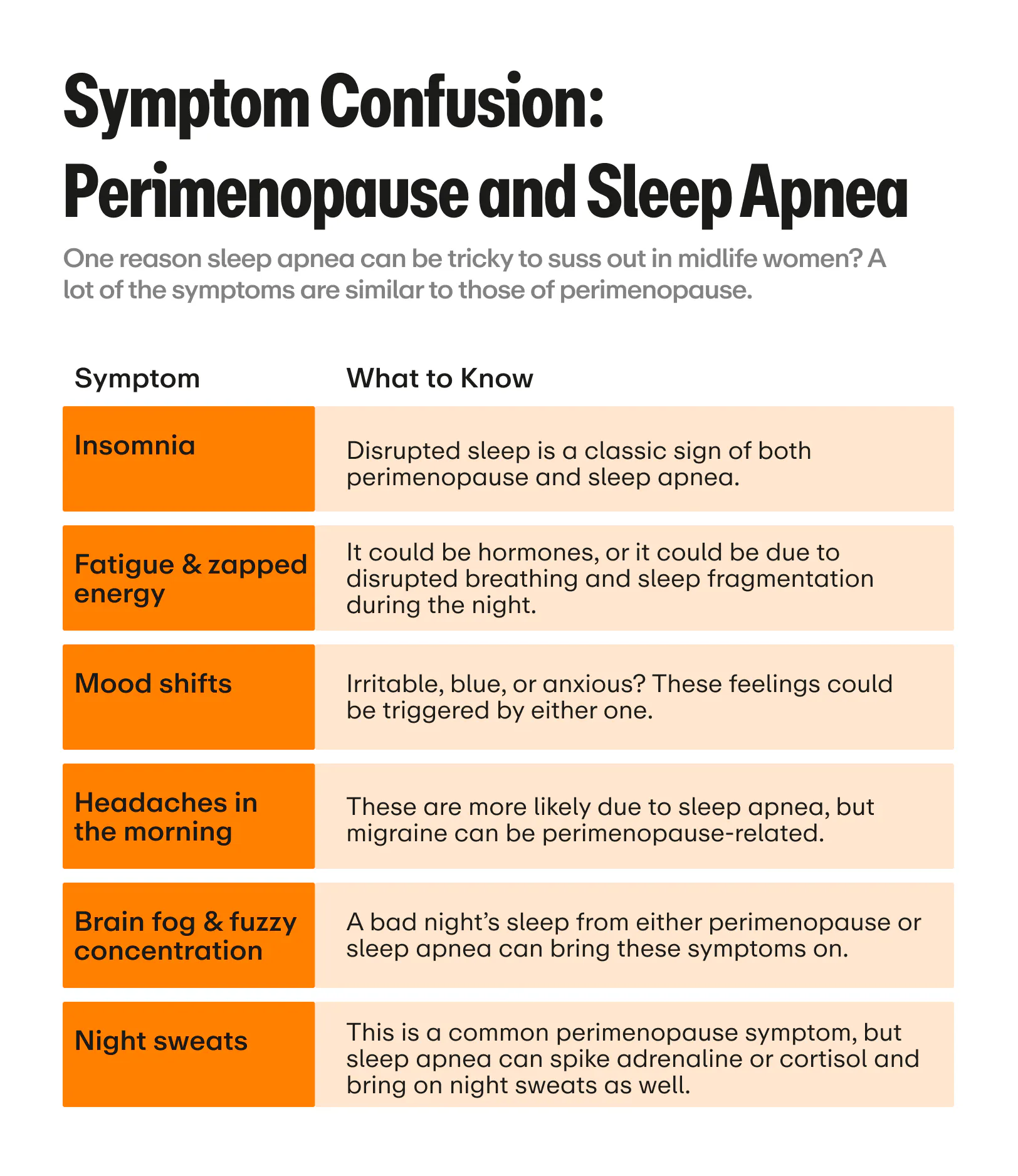
One of the reasons OSA is underdiagnosed in midlife women is that many of the symptoms overlap with changes that happen in perimenopause, including:
- Insomnia: Staring wide-eyed at the ceiling in the middle of the night is a classic sign of perimenopause, but it could also be triggered by disrupted breathing.
- Fatigue: Feeling low energy despite logging 8 hours could be due to hormones or disrupted, fragmented sleep.
- Mood changes: Mood shifts like irritability, depression, and anxiety are all possible in perimenopause and with sleep apnea.
- Morning headaches: This is more likely to be caused by overnight oxygen dips, but perimenopause can also bring on hormone-related migraine episodes.
- Brain fog or poor concentration: These are often related to a bad night’s sleep, which can happen thanks to either perimenopausal night sweats or fragmented sleep.
- Night sweats: This classic perimenopause annoyance can also be caused by sleep apnea, because the pauses in breathing trigger your body to release adrenaline and cortisol.
Risk Factors for Sleep Apnea in Women
There are a few main risk factors for obstructive sleep apnea in women:
- Family history: If your parents dealt with sleep apnea, you’re more likely to have it.
- Obesity or recent weight gain: Weight gain ups your risk, but so does the menopause body composition shift that changes where you store fat. That said, you can have sleep apnea when you’re at a healthy weight.
- Hypothyroidism: There’s an association between this condition and sleep apnea, but it’s not clear that it’s a defined risk factor.
- Polyendocrine metabolic ovarian syndrome (PMOS): Women with this syndrome (formerly known as polycystic ovary syndrome, or PCOS) are at increased risk of sleep apnea.
- Drinking alcohol or using sedatives at night: These substances can relax your throat muscles and slow down your brain’s signals to breathe.
What Happens if Sleep Apnea Goes Untreated?
Untreated sleep apnea can have real consequences. The low oxygen levels and fragmented sleep can raise your risk of health conditions like high blood pressure, type 2 diabetes, heart disease, and stroke. And when it comes to cardiovascular health, some research suggests that sleep apnea may be harder on women than men.
Health conditions aside, the overwhelming fatigue, brain fog, and mood changes can make it hard to enjoy and function in your life, and daytime tiredness potentially puts you at risk of accidents caused by drowsy driving.
So, is sleep apnea dangerous? Only if it doesn’t get the care it needs. Fortunately, it’s a very manageable condition, with a range of treatment options.
How Is Sleep Apnea Diagnosed in Women?
To get an official diagnosis of sleep apnea, you need a sleep test, either at home or in a clinic.
Home tests are (clearly) more convenient—you use a kit that monitors your breathing one night in your own bed. This involves placing a small probe over your finger to measure oxygen levels, a mask with tubes into your nostrils, and sensors on your chest and belly. This route is much less expensive than going to a lab, and it’s typically covered by insurance.
The results will show up as an apnea-hypopnea index, which will rank the severity of your sleep apnea. Your case is considered mild if you have 5 to 14 breathing disruptions per hour, moderate if you hit 15 to 29, or severe if you have more than 30 per hour. Just remember that women can have worse symptoms at lower numbers, so this might not capture the full picture of what you’re actually going through.
If the results of a home test are negative or inconclusive, a sleep specialist may recommend an overnight in-lab polysomnography, which is the gold standard for diagnosing OSA. If you have other medical conditions that could be related—like resistant hypertension or atrial fibrillation or other arrhythmias—your clinician might skip the home test and send you for a polysomnography right away.
If you want to ask to get screened, keep a log of your symptoms for at least 2 weeks. (If you have a wearable device that tracks fragmented sleep or oxygen saturation, that can be useful information—though these devices don’t diagnose sleep apnea.) Patterns like regular unrefreshing sleep or consistent morning headaches can be helpful information for a clinician when it comes to prescribing a sleep study.
Treatment Options That Work for Women
In terms of how to treat sleep apnea, there are several options for therapy. A primary therapy is wearing a mask connected to either a:
- CPAP (continuous positive airway pressure) machine, which gives you constant air pressure all night.
- APAP (auto-titrating positive airway pressure) machine, which changes the pressure as needed based on your breathing.
Of course, having a mask strapped to your face every night is not exactly the most comfortable way to sleep. But there are a variety of mask options, including some that only cover your nose or even just your nostril area.
You can also try some alternative (or add-on) therapies:
- Oral appliances: A custom mouth guard can pull your jaw and tongue forward to open up your airway. This can help in mild or moderate cases if you can’t stand the CPAP machine.
- Positional therapy: If your breathing issues happen only when you’re on your back, you can use certain tools (like supportive pillows or vibrating sensors) to encourage side sleeping instead.
- Upper airway surgery or treatment of nasal obstruction: There are some FDA-approved surgical treatments, such as hypoglossal nerve stimulation, which implants a device that stimulates the nerves to open the airways. This can help in patients with moderate-to-severe sleep apnea who can’t use or haven’t benefitted from a CPAP machine.
- Weight management: When relevant, losing weight can sometimes (though not always) reduce breathing problems.
In case you’re wondering: Hormone replacement therapy (HRT, now commonly referred to as menopause hormone therapy, or MHT) can certainly help you get a good night’s rest by reducing hot flashes and night sweats, but it isn’t a treatment for sleep apnea.
When to Talk With a Clinician About Your Sleep
Ask to get tested for sleep apnea ASAP if you notice any of these red flags:
- Someone has seen you pause in your breathing or gasp for air during sleep, and you’re sleepy during the day.
- You snore and also have hypertension or atrial fibrillation.
- Your tiredness affects your driving or working.
- You snore and have headaches in the morning.
Don’t give up if you’ve been told that your persistent daytime fatigue is “just menopause.” If you suspect sleep apnea, request a screening. Getting the treatment you need can make the difference between feeling relentlessly zonked and actually having the energy and focus (and mood!) to tackle your day.
Midi clinicians specialize in women’s midlife health and can evaluate your sleep symptoms in the context of menopause—and they won’t simply blame it on hormones. They can walk you through what it’d take to get a diagnosis and help you get the necessary treatment to put your symptoms to bed.
Key Takeaways
- Sleep apnea symptoms in women can look different than the classic ones (like loud snoring) you see in men: Women are more likely to experience fatigue, mood changes, insomnia, and morning headaches—and women may not snore at all. Anyone who has been newly diagnosed with high blood pressure would benefit from an evaluation for sleep apnea as an underlying cause.
- Sleep apnea is underdiagnosed. Many women go for years without getting a proper diagnosis, and some never receive one.
- The hormonal shifts of menopause increase your risk of sleep apnea. They can also make it tricky to pin down the problem, since many sleep apnea symptoms in women overlap with the effects of perimenopause.
- Diagnosis requires a sleep test, either at home or in a lab.
- The standard treatment for sleep apnea is using a CPAP machine at night, but there are also alternative therapies, such as oral appliances, that are increasingly being used.
Frequently Asked Questions (FAQs)
Can sleep apnea cause weight gain?
Untreated sleep apnea can indirectly cause weight gain by disrupting your sleep, which can lead to changes in the hormones that regulate your appetite. Sleep apnea can also leave you feeling too tired to exercise.
What gets mistaken for sleep apnea?
Upper airway resistance syndrome is similar to obstructive sleep apnea, but less severe. Sleep disorders like insomnia, restless leg syndrome, and circadian rhythm disorders also share symptoms with sleep apnea. Other medical conditions like COPD, depression and anxiety, and even ADHD can be mistaken for sleep apnea, too.
Can you live normally with sleep apnea?
Sleep apnea is very manageable. Sticking with the care plan—whether that’s using a CPAP machine, wearing a custom mouth guard, sleeping on your side, or another treatment your clinician recommends—can help you ease breathing problems that are disrupting your sleep.
How do you self-treat sleep apnea?
Some lifestyle changes, like sleeping on your side, avoiding alcohol, and maintaining a healthy weight can help some people reduce their sleep apnea symptoms. But moderate or severe cases typically require treatment.
How do I test myself for sleep apnea?
You can check for sleep apnea with an at-home test, but the kit requires a prescription from a clinician. You can start with the STOP-BANG survey and Epworth Sleepiness Scale to get a sense of your risk, though these don’t work as well as screenings for women.
If you’re in perimenopause or menopause and want guidance from clinicians who specialize in women’s midlife health, book a virtual visit with Midi today.
Hormonal change is at the root of dozens of symptoms women experience in the years before and after their period stops.
Our trained menopause specialists can help you connect the dots to guide you towards safe, effective solutions.
Whether you need personalized guidance or a prescription routine to tackle symptoms—including brain fog, hot flashes, sleep trouble, mood swings, and weight gain—we’ve got you covered. Learn more here.
Midi’s mission is to revolutionize healthcare for women at midlife, wherever they live and whatever their health story. We believe that starts with education, to help all of us understand our always-changing bodies and health needs. Our core values guide everything we do, including standards that ensure the quality and trustworthiness of our content and editorial processes. We’re committed to providing information that is up-to-date, accurate, and relies on evidence-based research and peer-reviewed journals. For more details on our editorial process, see here.