Liz Krieger


When we talk about vitamin B12 benefits for women, it often boils down to one key word: “energy.” And who doesn’t want more of that these days? Of course, B12 does a lot more than that in our bodies—it builds red blood cells, keeps nerves insulated, and supports brain and mood chemistry. After age 40, running low on B12 becomes more likely than you'd probably think, thanks to age-related absorption changes, as well as common midlife medications. Below, get the scoop on vitamin B12 benefits and side effects, what it really does for your body, ways to tell if you're low, and how a Midi Health clinician can give you guidance on this and all other aspects of midlife health.
You're tired in a way coffee doesn't touch. You walked into the kitchen and forgot why. And—weird—your feet tingle at night. Is it perimenopause? Low iron? Your thyroid? Or is it what your friend swears: that you’re missing out on vitamin B12 benefits for women?
Honestly, midlife can be a confusing time, because many symptoms of perimenopause and menopause can overlap with those from other causes—and yes, that can include being low in vitamin B12. It’s an essential vitamin for keeping your nerves healthy, producing red blood cells, converting food to energy, and more. Normal aging, plus certain medications, can affect how well your body absorbs it.
But that doesn’t mean that everyone needs to supplement B12. Here, we’ll cover the benefits of B12 that hold up to research, B12 deficiency symptoms, and why absorption drops after age 50. We’ll also explain how a clinician, like one at Midi, can help you with all the symptoms and issues that pop up in midlife.
What Are the Main Vitamin B12 Benefits for Women Over 40?
B12 is a water-soluble vitamin your body needs, from food or supplements, for many essential functions. Here’s an overview on what B12 does according to buzzy reports, with an honest read on the evidence:
- Produces red blood cells: B12 is needed to make mature red blood cells. Without enough, you get megaloblastic anemia. (This is different and less common than iron-deficiency anemia.)
- Provides energy—when you're deficient: Correcting a real B12 deficiency restores oxygen delivery (because of those red blood cells) and lifts fatigue. If you’re not deficient, B12 supplements don’t give you energy.
- Keeps nerves healthy: B12 maintains myelin, the protective insulation around nerve fibers.
- Helps with brain function and memory: Long-standing deficiency is a recognized reversible cause of cognitive symptoms. (Again, deficiency is the key here.)
- Has an effect on mood: B12 supports pathways involved in neurotransmitter production. A deficiency can have an impact on your mood, but supplements aren’t proven to help.
- Boosts heart health: B12 helps regulate homocysteine, an amino acid linked to cardiovascular risk. (But supplements haven’t been shown to prevent heart attacks or strokes).
- May support bone health (if you’re deficient): Low B12 tracks with lower bone density in observational research.
- Improves hair, skin, and nails: This is often claimed but rarely studied. The evidence is thin that supplements help.
Here’s the thing: Many of the benefits above show up when someone who is low on B12 starts getting enough of the vitamin. But in people without an overt deficiency, B12 supplementation generally hasn’t been shown to help.
Many of us get all the B12 we need from food. The best sources of B12 are meat, fish, eggs, dairy, fortified cereals and plant milks, and fortified nutritional yeast. When someone has impaired absorption, though, food alone may not be enough.
Can Vitamin B12 Help With Fatigue and Low Energy?
Yes, but only if you’re deficient in the vitamin. B12 is needed to build red blood cells that carry oxygen. When B12 levels fall, red blood cell production drops, oxygen delivery suffers, and you get heavy, persistent tiredness—often with breathlessness on stairs and pale skin.
B12 is not a stimulant. It doesn't work like caffeine, and it won't do anything for fatigue that isn't related to a deficiency. For example, a 2021 meta-analysis of randomized trials found no clear benefit for unexplained fatigue in people without a clear B12 deficiency.
Midlife fatigue can have many—often overlapping causes—including disrupted sleep, low iron, thyroid changes, and hormonal shifts. (Add in the never-ending challenges of work, kids, family, relationships….) A B12 deficiency is definitely something that’s considered, along with those other health concerns, when Midi clinician does a fatigue workup for patients. (Check out our related guides to vitamins for menopause fatigue and the best iron supplement for women.)
Vitamin B12, Brain Fog, Memory, and Mood in Midlife
B12 deficiency is a well-established, often reversible (especially when caught early) cause of cognitive impairment—forgetfulness, trouble finding words, poor concentration.
Here's the overlap issue: Estrogen shifts cause brain fog and lack of focus on their own. So it makes sense to have both looked at, rather than assuming it’s one or the other. If you’re not deficient in B12, then supplementing it won’t help, so it’s better to find out what’s going on.
B12 also plays a role in normal nervous system function, and deficiency can contribute to mood changes. But the evidence doesn’t support testing everyone for B12 who has symptoms of depression or anxiety, and B12 isn’t a treatment for those issues in people whose levels are normal.
How Does Vitamin B12 Protect Nerve Health?
B12 is essential for building and repairing myelin, the protective insulation around nerves. When it runs low, myelin degrades, and nerve signals misfire.
Symptoms can follow: tingling or numbness in hands and feet, burning sensations, unsteadiness, and balance trouble. These are easy to write off as a sign of getting older or as one more weird perimenopause thing. Don't. If B12 deficiency goes untreated for a long time, nerve damage can become permanent—so these symptoms are the most urgent reason on this list to get tested rather than guess.

Why Does B12 Absorption Drop After 50?
Absorption can drop for several reasons. How B12 is absorbed is a multi-step process: Food hits your stomach, your stomach acid frees B12 from the food, and a protein called intrinsic factor helps your body absorb it into the small intestine.
Several things can interrupt that process:
- Age and atrophic gastritis: Research in older adults found that those with atrophic gastritis (a condition that makes it harder to absorb B12) had lower B12 levels and other signs of deficiency. (This is why it’s recommended that adults over age 50 get much of their B12 from fortified foods or supplements, because it can be harder for their bodies to absorb B12 that’s naturally present in food.)
- Metformin: A review of 17 studies found that B12 deficiency was more prevalent among people taking metformin for type 2 diabetes than those who weren't, and the effect appeared to be related to dosage. Ask your clinician about monitoring if you take metformin for prediabetes, type 2 diabetes, insulin resistance, or polyendocrine metabolic ovarian syndrome (PMOS, formerly known as polycystic ovary syndrome, or PCOS).
- Some acid reflux medications: Proton pump inhibitors (PPIs) and histamine-2 receptor antagonists (H2 blockers) may suppress the acid that B12 needs to be absorbed. The evidence here is mixed, but long-term use is worth mentioning to your clinician.
- GLP-1s and eating changes: Evidence on this is still limited, but one small study of people taking semaglutide after sleeve gastrectomy saw B12 fall significantly over 12 months, likely tied to eating less meat. Regardless of the medication, smaller portions and a vegetarian or vegan diet without added fortified foods or supplements can reduce B12.
- Surgery: Gastric bypass and sleeve procedures reduce B12 absorption.
- Pernicious anemia: This autoimmune condition is more common in women. Pernicious anemia can reduce B12.
- Heavy alcohol use: This can also reduce B12.
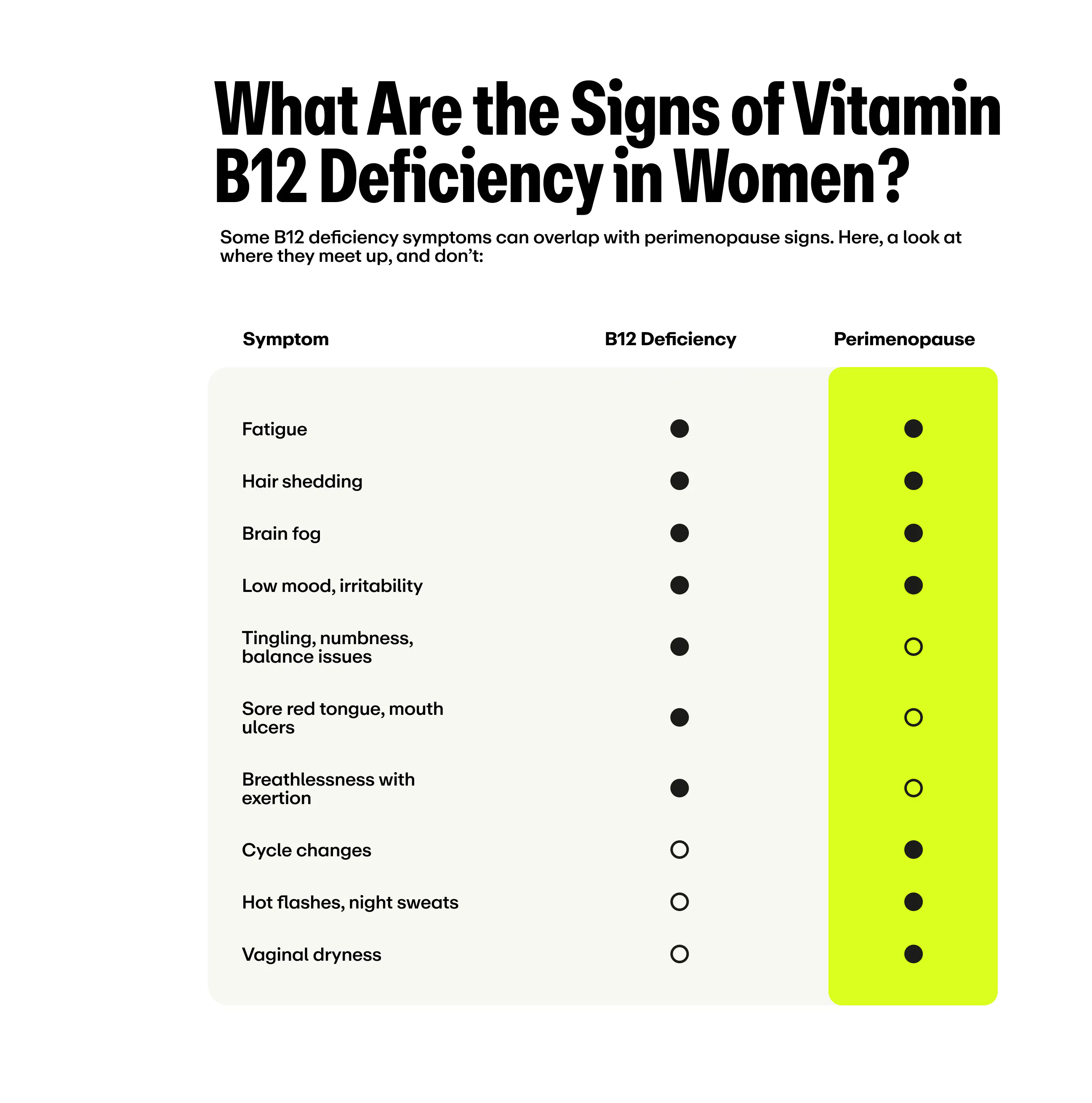
What Are the Signs of Vitamin B12 Deficiency in Women?
Some B12 deficiency symptoms can overlap with perimenopause signs. Here’s a look at where they meet up and where they don’t.
Your liver stores several years' worth of B12, so a deficiency develops slowly, possibly from a change in your eating or a medication you started a few years ago. Also important to know: B12 and iron deficiency can coexist and partly mask each other on a basic blood count.
How Is Vitamin B12 Tested, and What Do the Numbers Mean?
A serum B12 test is not included as part of a standard blood draw, and universal screening isn’t recommended. Your clinician needs to order it specifically, if needed.
Who should consider testing:
- women over age 50
- anyone taking metformin or long-term acid reducers
- GLP-1 users who are now eating substantially less
- plant-based eaters
- anyone who’s had bariatric surgery
- anyone with the nerve symptoms described above
If a test shows that your B12 level is in the low-normal range, this can still cause symptoms. That’s why U.S. clinical guidance recommends a second-line test—methylmalonic acid (MMA)—when the first result lands in that gray zone. MMA rises when cells are functionally short on B12, even if the blood-test number looks acceptable.
One practical note: If you’re going to be tested, let your clinician know if you've recently started a high-dose supplement, since it may obscure the result.
One advantage of testing is that it can turn guesswork about worrisome symptoms into certainty, and then your clinician can guide your treatment with confidence. A Midi clinician can order testing when needed and help you interpret the results.

Which Form of B12 Is Best?
B12 supplements come in several forms; the two most common are methylcobalamin and cyanocobalamin, which are processed differently in the body.
Methylcobalamin is a bioidentical, better-absorbed form, and it’s preferred by Midi clinicians. Cyanocobalamin is less expensive, stable, and well-studied. Each of them can correct a deficiency.
B12 is available via oral supplements and injections. When it comes to B12 shots vs. pills, a study review found that both could bring serum levels back to normal. Injections are often used to start treatment when deficiency is severe, when there are nerve symptoms, or when levels need to come up quickly. Many people with pernicious anemia or past weight loss surgery can then do well on high-dose daily pills.
B12 injections are not an energy booster for people who aren’t deficient, and that’s especially true with “med spa” shots.
Vitamin B12 Benefits and Side Effects: How Much Is Safe?
The recommended amount for adults is 2.4 micrograms (mcg) of B12 daily—a tiny amount. Supplements contain hundreds of times that because only a small fraction of a large oral dose is absorbed.
B12 is water-soluble, and there's no established upper limit, since your body just excretes the excess. That isn't a reason to go overboard though. At high doses, some people report acne flares, headache, nausea, or diarrhea. And B12 shots can cause reactions at the injection site and, rarely, allergic reactions.
If you have kidney disease or Leber hereditary optic neuropathy, check with a clinician before taking B12. In general, it’s a good idea for everyone to check with a clinician before starting a new supplement, especially if you take prescription medications that could interact with it.
Is It Low B12 or Perimenopause? How to Sort It Out
Fatigue, brain fog, mood shifts, and tingling: These could be related to hormones, nutrition, your thyroid—or all three. The treatments are completely different, which is why guessing what’s behind your symptoms isn’t the most efficient way to ease them.
Some hints:
- Clues pointing toward low B12: You're over age 50, you take metformin or an acid reducer, you're on a GLP-1 and are now eating less, your diet is plant-based, you've had bariatric surgery, you have nerve symptoms, or a past lab showed anemia.
- Clues pointing toward perimenopause: Your menstrual cycle is fluctuating, you have hot flashes and night sweats, you’re experiencing vaginal dryness.
- If you’re having symptoms, consider this plan: Ask your clinician whether you can be tested for B12, iron, and thyroid levels together, rather than one after another. Then, you can work with your clinician on a treatment plan to correct any deficiency. And discuss how to ease menopause symptoms with evidence-based options, if hormones seem to be the driver.
Midi clinicians specialize in midlife women's health, and they can order those labs, analyze them in context, and build an individualized Care Plan around what's actually causing your symptoms.
Key Takeaways
- B12 is key for red blood cell production, nerve protection, DNA, and more. Most benefits from taking supplements appear when someone is fixing a deficiency—not as a boost for people with normal B12 levels.
- Absorption can decline after age 50. It can also be affected by metformin, long-term acid reducers, bariatric surgery, and reduced eating while taking GLP-1s.
- Some symptoms of B12 deficiency mimic perimenopause symptoms. Nerve symptoms, a sore red tongue, and pallor are the signs that make B12 worth checking.
- Test, don't guess. A B12 blood test—plus MMA when the result is borderline—turns a hunch into a plan.
- B12 supplements are available in two common forms. Methylcobalamin and cyanocobalamin both work. High-dose oral supplements work for most people. Injections are often used to start treatment when deficiency is severe.
Frequently Asked Questions (FAQs)
What happens if I take B12 every day?
If your B12 levels are low and you take supplements, your levels will rise over weeks and deficiency-related symptoms will start to improve. If your levels aren’t low, you’ll see very little difference—excess B12 is water-soluble and largely excreted. Daily supplementation is common for people on metformin, plant-based eaters, and adults over age 50 with reduced absorption.
What happens to your body when you start taking B12?
If you are deficient in B12, red blood cell production improves first, usually within weeks, and then increased energy will follow. Nerve symptoms take longer and may only partially resolve if the deficiency was long-standing. If your levels were normal to start with, there won’t be a noticeable change.
Who should not take B12?
Most people can take B12 safely. Check with a clinician first if you have kidney disease or Leber hereditary optic neuropathy, or a Cobalt/B12 allergy. And if you take prescription medications, ask whether they interact. Anyone with unexplained neurological symptoms should be evaluated before supplementing, so treatment doesn't obscure the diagnosis.
How long does it take for vitamin B12 to work?
If you have a deficiency and take supplements, blood levels start to rise within days to weeks. Fatigue and anemia-related symptoms typically improve over 4 to 8 weeks. Neurological symptoms are much slower and may not fully reverse if the deficiency went untreated for a long time.
Can low B12 cause weight gain?
Not directly. Low B12 causes fatigue, which can reduce activity, and that's the most plausible indirect link. There's no good evidence that correcting B12 produces weight loss. Midlife weight change usually involves sleep, hormones, muscle mass, and metabolic shifts together.
If you’re in perimenopause or menopause and want guidance from clinicians who specialize in women’s midlife health, book a virtual visit with Midi today.
Hormonal change is at the root of dozens of symptoms women experience in the years before and after their period stops.
Our trained menopause specialists can help you connect the dots to guide you towards safe, effective solutions.
Whether you need personalized guidance or a prescription routine to tackle symptoms—including brain fog, hot flashes, sleep trouble, mood swings, and weight gain—we’ve got you covered. Learn more here.
This article is for informational purposes only and does not constitute medical advice. The information contained herein is not a substitute for professional medical advice, diagnosis, or treatment. Always consult a qualified healthcare professional with any questions regarding a medical condition or before starting any new treatment.
Midi’s mission is to revolutionize healthcare for women at midlife, wherever they live and whatever their health story. We believe that starts with education, to help all of us understand our always-changing bodies and health needs. Our core values guide everything we do, including standards that ensure the quality and trustworthiness of our content and editorial processes. We’re committed to providing information that is up-to-date, accurate, and relies on evidence-based research and peer-reviewed journals. For more details on our editorial process, see here.