

If you started taking progesterone and are feeling crummy—bloated, moody, anxious—from side effects, you might be wondering whether it’s possible to have a progesterone intolerance. The short answer? Progesterone sensitivity or intolerance is real. It seems to affect a small percentage of women, and it may make you think about stopping the medication. But rather than quitting progesterone on your own, talk with your healthcare professional: It’s possible to make adjustments (in dose or timing, for example) to help you get the benefits with less disruptive side effects—or none at all. A menopause-trained clinician, like one at Midi Health, can guide you through the process.
If a lightbulb has gone off in your brain and you realize, Hey, I’m feeling worse on hormone therapy, not better!, the issue might be progesterone intolerance. Maybe you had a night out with friends who are all raving about how great they feel on hormone replacement therapy (HRT, now commonly referred to as menopause hormone therapy, or MHT), but there you are, with the opposite take: Progesterone makes me feel awful.
If this describes your experience on the hormone, know that you’re not alone—and you should never be told that you just need to push through your symptoms. You don’t. Progesterone sensitivity is a known concern with several possible solutions.
In fact, we’ll outline six specific options for dealing with progesterone intolerance that a clinician can work through with you. Remember: A clinician’s guidance is key here. Progesterone is an important part of HRT—among other things, it provides protection to the uterus when you’re also taking estrogen. Any changes to your medication or treatment should come from a healthcare professional, like one of the menopause-trained clinicians at Midi. Keep reading for details that will help inform that conversation.
What Is Progesterone Intolerance?
Progesterone intolerance is a pattern of symptoms—physical, mood-related, or metabolic—that are triggered by progesterone or its synthetic (lab-made) form, progestin. When you take the medication, you could have specific side effects or just a sense of not feeling well, explains Midi physician Rebecca Yee, MD, FACOG.
“Intolerance” and “sensitivity” are both terms used to describe this reaction—but regardless, this is different from an allergy. An allergy, explains Dr. Yee, “involves an immune response by the body, such as a rash, hives, or sometimes anaphylaxis, where the reaction can cause swelling in the airway and difficulty breathing.”
If you have an allergy to a medication, you should not take that medication at all. But if you have a progesterone intolerance or progesterone sensitivity, there may be ways you can change how you take it to limit side effects and get the results you were hoping for.

How Do You Know If It’s Progesterone Intolerance?
When your body seems to react negatively to micronized (bioidentical) progesterone or synthetic progestins, you may have questions about its side effects, like “Can progesterone cause anxiety?” and “Am I feeling bloated because of progesterone?”
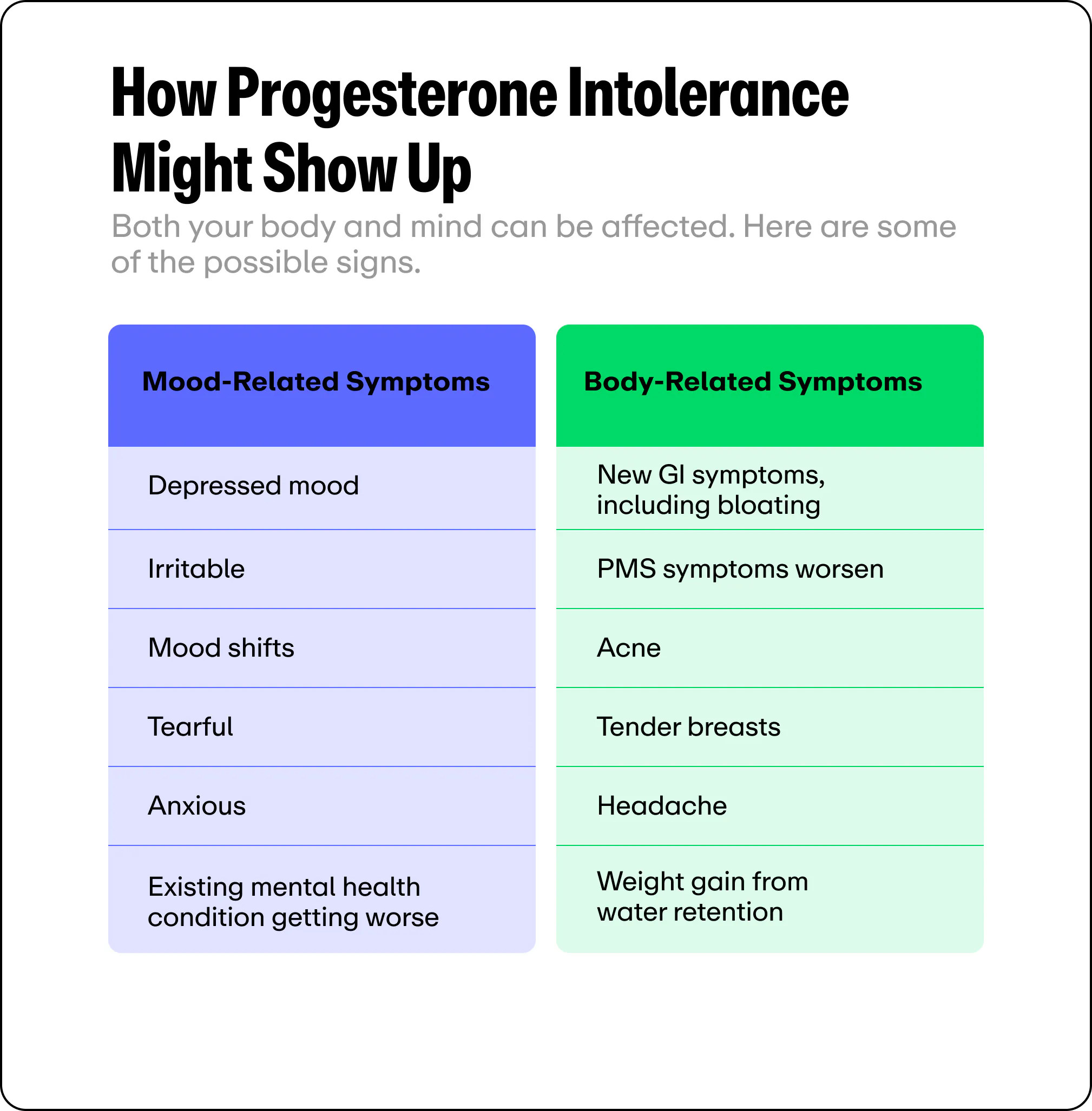
Here are some of the mood-related progesterone intolerance symptoms to know about:
- depressed mood
- irritability
- mood shifts
- tearfulness
- anxiety
- worsening symptoms of an existing mental health condition
Other potential physical symptoms may include:
- new gastrointestinal (GI) symptoms, such as bloating
- weight changes from water retention
- acne
- breast tenderness
- headache
- more severe PMS symptoms
You might also notice mild side effects, such as drowsiness and fatigue. Dr. Yee says that these are typically tolerable, but every woman reacts individually. Some spotting is expected early on, or as a scheduled withdrawal bleed if you’re on a cyclic progesterone regimen—but unscheduled, persistent, or new bleeding isn’t something to wait out and warrants an evaluation from a healthcare professional.
The timing of your symptoms is one clue to pay attention to. Track whether your symptoms tend to start on days you take progesterone (if you take it cyclically, rather than every day) and ease when you stop.
Why Do Some Women React to Progesterone?
It can seem strange that you can react to progesterone when it’s a hormone your own body makes naturally. Dr. Yee explains the biology: When our bodies metabolize or break down progesterone—whether it’s progesterone that the body makes naturally or that’s part of HRT—metabolites are produced (a byproduct of metabolism). These metabolites can act on different systems in the body, including pathways that regulate fluid balance, skin oil production, and brain chemistry. Some people are sensitive to the metabolites—and that’s why reactions to progesterone can show up as fluid retention, acne, mood changes, or worsened PMS symptoms.
If you’re sensitive to progesterone, however, you don’t have to ditch it completely. You have a lot of options for making adjustments (more on those below), which can help you continue taking it and getting the benefits.
Why You Shouldn’t Just Stop Progesterone on Your Own
If you have a uterus, progesterone is crucial. It’s what helps protect your uterine lining from the effects of estrogen. Without progesterone, estrogen can cause the lining to abnormally thicken, and it can increase your risk of developing endometrial cancer.
Research shows that estrogen-progesterone hormone therapy decreases endometrial cancer risk by 35% compared with a placebo group. So don’t stop taking progesterone on your own—talk with your clinician about your options. (Women who don’t have a uterus may not need progesterone, but that’s still a conversation to have explicitly with your clinician.)

If your symptoms are severe, don’t wait until your next visit with your clinician—get in touch now and talk through what to do next and how to mitigate your symptoms. One important exception: If you experience suicidal thoughts, immediately stop taking progesterone and contact a crisis lifeline (such as 988) or emergency services.
For less severe symptoms, though, you don’t have to choose between white-knuckling it and stopping progesterone altogether. There are several ways your clinician can adjust your treatment so you can keep getting the benefits without the disruptive side effects.
Option 1: Ask Your Clinician About Another Progesterone Form
The first thing to talk to your clinician about: Should you consider switching the type of progesterone you’re taking, whether it’s synthetic or micronized (bioidentical) progesterone?
You can have progesterone intolerance while taking either type of progesterone, but generally, mood changes tend to be less common with micronized progesterone than with synthetic progestins.
In any case, it’s important to take these symptoms seriously and talk with your clinician about whether to try something different.
Your clinician may also advise trying a couple of weeks off of progesterone to see whether that resolves your symptoms—that can give them a better idea of what’s going on. However, only do this under the guidance of your clinician.
Option 2: Change How You Take It
Progesterone can be delivered to your body in a few ways: as an oral pill, vaginally, or via a hormonalIUD (which delivers synthetic progestin, not progesterone itself—more on IUDs below). Your clinician might recommend switching from an oral capsule to vaginal progesterone to see whether that helps; vaginal progesterone reduces the amount that’s metabolized by the liver, which can blunt the mood side effects.
This is considered off-label use—when a clinician prescribes a medication to be used in a different way (or dose) or for a different condition than it was approved for by the FDA. That’s one reason it’s key to have a clinician who has expertise and knowledge in menopause and women’s healthcare (like the clinicians at Midi), since they can tailor your treatment to your individual needs.
What Success Looks and Feels Like
Option 3: Adjust the Dose or the Schedule
In terms of how to reduce side effects of progesterone, adjusting the dose or schedule can make a difference. Depending on what dose you’re taking, your clinician can decrease the dose or, through custom compounding, prescribe a 50-milligram (mg) twice-daily dose of micronized progesterone. This lower, divided dose might be better tolerated.
The caveat here is that you still need a dose that provides adequate protection to your uterus if you’re on estrogen therapy, adds Dr. Yee. When it comes to progesterone dosage for menopause, the minimum dose that Midi prescribes is 100 mg (a common starting dose).
Option 4: Consider Local Delivery With a Hormonal IUD
Certain hormonal IUDs (namely Mirena or Liletta) release progestin into your body and can provide endometrial protection and pregnancy prevention.. (They can also help decrease heavy period bleeding, if that’s a concern for you.)
In terms of mood-related side effects, you might find that you can better tolerate a progesterone IUD. That’s because with this form, there’s some systemic absorption of progestin, absorption of progestin in the bloodstream, “but at a lower dose than oral progesterone," says Dr. Yee. Some IUDs (but not all) can give you an adequate amount of progesterone to protect your uterus; your clinician can give you guidance about which type is best for you.
An IUD insertion and its eventual removal require office visits with a clinician. Depending on the type you use, these devices are designed to last anywhere from 3 to 8 years for contraception purposes and 4 to 5 years for endometrial protection.
Option 5: Move Your Dose and Protect Your Sleep
Some women notice that they’re sleepier or more fatigued when they take progesterone. That’s why it’s suggested to take progesterone at bedtime. If you find that you’re groggy the next day, you can talk with your clinician about taking the dose earlier in the evening.
There’s a mental-health bonus to getting a better night’s sleep: It can indirectly reduce anxiety and depression, research shows, possibly by helping you better manage your emotions.
Several factors affect the best time to take progesterone, including:
- if you’re in perimenopause or postmenopause
- the side effects that you experience
- whether you’re also taking estrogen as part of hormone therapy
Talk with a healthcare professional, like a Midi clinician, about whether changing your dose timing could help with mood symptoms.
Option 6: Address What Amplifies the Symptoms
In midlife, mood symptoms are rarely caused by one thing. Instead, all of life’s challenges come together and hand you a nice stress-meets-moodiness gift. Meaning, so many things can magnify progesterone-related mood symptoms, including blood sugar swings, unmanaged or unacknowledged sources of stress, poor sleep, and alcohol intake.
But when you make healthy lifestyle shifts, it may help blunt some of those mood symptoms. This includes practicing good sleep habits, eating protein- and fiber-forward meals, drinking less alcohol, and finding your best route to less stress. It’s also a good step to seek professional support for perimenopause anxiety and mental health conditions.
All that said: Lifestyle shifts can be supportive moves, but they aren’t a substitute for a clinician-guided prescribing change.
How to Work With a Clinician to Find the Right Fit
Clinician support is so important when you’re dealing with side effects of progesterone. When you have a conversation about what you’ve experienced, be ready with a history of the hormonal medications you’ve taken.
If you can, before your visit, start keeping a log of side effects and symptoms, as well as the progesterone dose and timing. This can make cause-and-effect patterns easier for your clinician to see.
Your clinician can review the type of progesterone you're taking, the route, dose, and schedule—these are all separate factors that they can adjust. Your clinician should also talk with you about lifestyle factors that may have an impact on your symptoms and changes that can support your well-being.
Finding the right combination of care might take a few adjustments, so you and your clinician should have a schedule of regular follow-ups. This is the level of clinician-led, menopause-informed care that’s available at Midi. If you’re ready, consider taking the next step to book a visit to explore and work through your options.
Key Takeaways
- Some women experience unwanted side effects while taking progesterone. This is commonly called progesterone intolerance or progesterone sensitivity, and it’s a pattern of symptoms that can be triggered by taking micronized progesterone or synthetic progestin.
- Some of these symptoms are mood changes, such as a depressed mood, irritability, tearfulness, and more.
- Other symptoms of progesterone intolerance may include fluid retention, bloating, breast tenderness, and acne.
- A progesterone intolerance does not mean you need to stop taking hormone therapy. A clinician can suggest changes that can make it more tolerable for you. This may include adjusting the form (say, changing from micronized progesterone to synthetic progestin), changing from oral to vaginal, or taking a different dose.
- Adjustments should always be done under the guidance of a clinician. It’s not advised to stop taking progesterone without talking with your clinician.
Frequently Asked Questions (FAQs)
How do I know if my body is rejecting progesterone?
Common symptoms of progesterone intolerance or sensitivity include mood changes, fluid retention, and bloating after starting progesterone. This isn’t necessarily indicative that your body is rejecting progesterone, but rather that you haven’t yet found the best way to take it for your body.
What happens if you can't tolerate progesterone HRT?
You definitely don’t need to just live with or push through your symptoms. Talk with a clinician who can help you mitigate these symptoms and consider the ways in which your prescription can be adjusted, possibly by changing the form of progesterone, how you take it, or dosing or schedule.
Is progesterone intolerance the same as a progesterone allergy?
No. A progesterone intolerance (also called sensitivity) means that taking progesterone gives you unwanted side effects. An allergy is an immune reaction that, when severe, can cause life-threatening reactions like anaphylaxis.
How long do progesterone side effects usually take to settle?
Side effects can start to get better once your body adjusts to progesterone. The timing can be different for all women, but it can be anywhere from a few weeks to months. Mild start-up side effects often ease within the first 1 to 3 months as the body adjusts, so an initial trial period is reasonable. But if you experience progesterone side effects that persist beyond about 3 months, or severe symptoms at any point, that warrants a clinician-guided change sooner rather than waiting around and seeing if things improve.
Can you take estrogen without progesterone if you have a uterus?
Generally, no. Doing this can cause the endometrial lining to abnormally thicken, putting you at increased risk of endometrial cancer. Adding progesterone decreases this risk. In certain rare situations, your clinician may suggest taking estrogen only—but this is only for specific situations, after discussing risks and benefits, and through close monitoring.
In some cases, instead of adding a progestogen, a clinician may prescribe Duavee, a single pill combining conjugated estrogens with bazedoxifene, a medication that protects the uterine lining in place of progesterone. This can be a good option for women who don't tolerate progestogen side effects. (Duavee is used on its own; additional estrogen should not be taken with it.)
If you’re in perimenopause or menopause and want guidance from clinicians who specialize in women’s midlife health, book a virtual visit with Midi today.
Hormonal change is at the root of dozens of symptoms women experience in the years before and after their period stops.
Our trained menopause specialists can help you connect the dots to guide you towards safe, effective solutions.
Whether you need personalized guidance or a prescription routine to tackle symptoms—including vaginal dryness and irritation, brain fog, hot flashes, sleep trouble, mood swings, and weight gain—we’ve got you covered.
Midi’s mission is to revolutionize healthcare for women at midlife, wherever they live and whatever their health story. We believe that starts with education, to help all of us understand our always-changing bodies and health needs. Our core values guide everything we do, including standards that ensure the quality and trustworthiness of our content and editorial processes. We’re committed to providing information that is up-to-date, accurate, and relies on evidence-based research and peer-reviewed journals. For more details on our editorial process, see here.