


Vaginal dryness, burning, bladder changes, painful sex—not exactly cocktail-party convo, we know. But genitourinary syndrome of menopause (GSM) is so incredibly common that it really deserves a seat at the table. The awkwardness of talking about it shouldn't stand between you and feeling better, especially with so many effective options within reach. We’ll talk about what causes GSM, what it feels like day to day, why women don’t seek help for it, and treatments that can help ease the discomfort and pain. Welcome to your stigma-free guide to GSM.
Today’s world is crammed full of acronyms. People talk about GLP-1s to improve their BMI, and if you have a teen, their texts are probably full of “WYDs” and “IYKYKs.” Well, if you’re one of the 75 million U.S. women currently navigating perimenopause, menopause, or postmenopause, we’ve got one more need-to-know acronym for you: GSM.
Short for genitourinary syndrome of menopause, GSM is an umbrella term used to describe a group of bothersome vaginal, urinary, and sexual symptoms that frequently crop up in midlife. For the first decades of our lives, estrogen helps nourish, lubricate, and protect tissues in the vagina, vulva, bladder, and urinary tract. And then when estrogen levels fluctuate and fall during perimenopause and menopause, those tissues become vulnerable to changes in functioning.
More than half of women experience symptoms of GSM after menopause, but up to 15% of women have them before menopause, too. Symptoms include:
- vaginal dryness, including tightness, burning, irritation, soreness, discomfort with movement, and a “sandpaper” feeling in or around the vagina
- lack of lubrication and/or pain during sex
- bleeding or spotting after sex
- urinary challenges, including increased frequency, burning, a “gotta go now” sense of urgency, incontinence, and recurrent urinary tract infections (UTIs)
“These symptoms are so common,” says Kathleen Jordan, MD, Chief Medical Officer at Midi Health. “Everyone will experience vaginal or urinary symptoms, whether it’s in early or late perimenopause or postmenopause.” Luckily, treatments exist that can help ease, and often eliminate, symptoms of vaginal dryness, painful sex, and other GSM struggles.
But what is genitourinary syndrome of menopause, exactly? Below, we’ll dive deeper into what GSM involves, what it can feel like, and why it happens, plus offer diagnosis and treatment tips you can use—starting today.
What Is Genitourinary Syndrome of Menopause?
Genitourinary syndrome of menopause (GSM) is a common condition characterized by bothersome vaginal, urinary, and sexual symptoms that can show up in midlife. “Just like the skin on your hands gets drier, thinner, and less elastic as you age, the same thing happens in your vaginal tissues,” Dr. Jordan explains.
One of the main reasons: loss of estrogen in midlife. We have estrogen receptors throughout our body, including the vulvovaginal tissues and the lower urinary tract—meaning these tissues rely on estrogen to thrive. Here’s how it works:
- Estrogen nourishes vaginal tissues: The hormone helps maintain vaginal blood flow and lubrication, and it keeps the vaginal walls thick and elastic. When estrogen declines in midlife, tissues in the vagina and vulva grow progressively thinner, drier, weaker, and more irritation-prone. You may experience itching, burning, soreness, or throbbing. Friction from sex, exercise, or even clothing can lead to rawness and create micro-tears and bleeding in this uber-delicate tissue.
- Estrogen keeps the urinary tract in prime shape: Your lower urinary tract also responds to estrogen deprivation. “Lower estrogen means less tone, so you get weaker urethral muscles and reduced muscle strength in the pelvic floor,” Dr. Jordan says. This can result in a need to urinate more frequently or urgently, an inability to control urination (incontinence), burning with urination, and increased susceptibility to UTIs.
- Estrogen helps maintain an optimal vaginal microbiome: A healthy vagina is mildly acidic, which helps protect against harmful bacterial overgrowth. Estrogen helps feed lactobacillus bacteria, which has anti-inflammatory and antimicrobial properties. As estrogen levels diminish, so do the levels of that bacteria, causing vaginal pH to rise. A less acidic vaginal microbiome is more vulnerable to irritation, changes in discharge or odor, and infections.
Symptoms of GSM can begin anytime in midlife, including in perimenopause, when you still have your period. It often worsens after the final menstrual period as estrogen reaches its lowest sustained levels. And unlike some other midlife symptoms that eventually resolve on their own, such as hot flashes or irregular periods, GSM gets worse without treatment.
What Success Looks and Feels Like
GSM Menopause Symptoms: What It Can Feel Like Day to Day
Symptoms of vaginal dryness, including vaginal burning and stinging and painful sex, are among the most common GSM concerns. The estimates of how many women experience GSM range widely, from 27% to 84%.
Vaginal, vulvar, and urinary discomfort isn’t just a little nuisance. In fact, research shows that women who are affected view the declines in their quality of life similar to those of patients who have chronic conditions like arthritis, irritable bowel syndrome, and chronic obstructive pulmonary disease.
Real-world anecdotes paint a clear picture of just how miserable GSM can be:
- “For almost a month, I was convinced I had a urinary tract infection. I was prescribed antibiotics, but they didn't work, because it wasn't an infection at all. It took a month to find out it was perimenopause.” —Sonja, 43
- “When a Pap smear at age 56 was so painful that I could barely take it, my doctor suggested I see an OB/GYN who specialized in menopause and perimenopause. In addition to dryness, for about 3 years I’d been having episodes where I desperately had to urinate and could barely control it until I got to the bathroom." —Amy, 59
- “I went through a somewhat early menopause and the dryness worsened every year. By my mid-60s, sex became not only uncomfortable and painful, but I was unable to feel pleasure. Naturally, I didn't want to do it for very long.” —Belle, 75
- “My initial menopausal symptoms were hot flashes and irregular periods. Two years ago came the big doozy: horrible vaginal itching and soreness. Now I’m dealing with frequent post-intercourse UTIs this year—I get infections about one out of every three times I have sex.” —Sandra, 58
GSM can also affect:
- Mood: If your vagina constantly aches or you’re leaking urine, it makes sense your mental health might take a hit. In one study, women who were newly diagnosed with symptoms of GSM were more apt to experience symptoms of anxiety and depression than their GSM-free peers.
- Overall quality of life: In one report, about 60% of women reported that symptoms like vaginal dryness and irritation took a toll not just on their libido, but also on their sleep, mood, and even general enjoyment of life.
Why Many Women Don’t Seek Help for GSM
Despite how common GSM is, the condition remains significantly underreported. Research suggests that 70% of women with signs and symptoms of GSM don’t bring it up with their healthcare professional, and fewer than half of those affected are using available tools to ease their discomfort.
Among the reasons GSM flies under the radar:
We assume it’s simply a part of aging, and we just have to deal with it
In a survey of nearly 2,000 U.S. women—all of whom were at least age 45 and experiencing GSM symptoms—most (72%) had never discussed their symptoms with a healthcare provider.
The main conversational barrier? “They believed [it] was just a natural part of aging and something to live with,” the authors wrote.
We’re embarrassed
It’s not exactly easy to talk about vaginal dryness and itchiness, urine dribbling, or sandpaper sex. And it sure doesn’t help that as recently as 2014, the medical community used "vaginal atrophy" to describe the thinning, dryness, and inflammation of the vaginal walls that so often occurs when estrogen levels decrease.
In 2014, the International Society for the Study of Women's Sexual Health and The North American Menopause Society (now The Menopause Society) retired the term "vaginal atrophy" and replaced it with GSM. The newer name was meant to help reduce stigma, as well as more accurately describe the spectrum of symptoms involved. Remember: reduced estrogen levels don’t have an impact on just the vagina.
We think we have an infection or some other issue
For example: Relentless vaginal itching often screams “Yeast infection!” Or when you find yourself peeing fire, it’s easy to blame a UTI. But the treatments for each of those infections won’t help GSM.
GSM symptoms can also masquerade as contact dermatitis, bacterial vaginosis, or skin conditions such as eczema. All in all, if your healthcare professional isn’t menopause-savvy or you’re self-medicating, it can be easy to misdiagnose GSM.
Diagnosing Genitourinary Syndrome of Menopause
This is where a menopause-aware clinician shines. Midi clinicians are experts in midlife health who are experienced in delivering compassionate, nonjudgmental care, so there’s no need to hesitate to bring up vaginal dryness, painful sex, incontinence, or any other GSM symptom you may find embarrassing.
“The majority of women we see in peri- and postmenopause are having these issues, so it’s an everyday conversation for us,” Dr. Jordan reassures. Some things your visit will cover:
- The clinician will ask about your medical history (including where you are on the perimenopause-menopause spectrum)
- They’ll want to know about distressing symptoms you’re experiencing and how they affect your day-to-day life, including comfort, sex drive, self-esteem, and sleep.
- They may refer you for a pelvic exam, where your vaginal and vulvar tissues can be assessed for thinning, elasticity, and signs of irritation or inflammation.
- They may prescribe lab tests to rule out underlying health conditions, including vaginal infections and other GSM impostors. (For instance, a urine culture can help distinguish whether the burning is from a UTI.)

Treatment Options: What Helps Most
Though GSM is chronic and progressive, it’s also one of the most treatable conditions in midlife. To restore and maintain vulvovaginal health, estrogen is key (more on that below). Here are a few available options to relieve various symptoms:
Over-the-Counter Vaginal Moisturizers and Lubricants
Vaginal lubricants and moisturizers are widely available and great to keep on standby.
- Vaginal lubricants: These are liquids or gels that you apply before and during sex to make the vulva and vagina wetter. (Using condoms? Be sure to choose a water- or silicone-based lube, as oil-based ones weaken condoms.)
- Vaginal moisturizers: These build moisture in vaginal cells, so that you’re naturally more hydrated, improving sex as well as everyday comfort. You need to apply them several times a week, regardless of plans for sex. Midi clinicians recommend the vaginal moisturizing products by the brands Good Clean Love and Revaree by Bonafide.
Prescription Option: Non-Systemic (Local) Estrogen Therapy
If moisturizers aren’t doing the trick to restore and maintain vulvovaginal health, prescription local vaginal estrogen is the gold-standard treatment. It delivers a low but powerful dose of quenching estrogen directly to vaginal tissues, restoring lubrication, thickness, elasticity, and a healthy pH without significant systemic absorption.
Local vaginal estrogen has been shown to eliminate GSM symptoms in 80% to 90% of women, and may even cut UTI frequency. It’s considered safe for most women, including many breast cancer survivors. Vaginal estrogen is available as a cream, suppository or tablet insert, or a ring that’s inserted like a diaphragm (and switched out after about 90 days).
Prescription Option: Systemic HRT
Dealing with significant hot flashes, night sweats, or mood symptoms on top of GSM? Systemic hormone replacement therapy (HRT), such as pills or patches, may be a good fit. It’s somewhat less effective than local vaginal estrogen for GSM—it alleviates vaginal dryness in about 75% of cases—but it can also relieve your other menopausal symptoms. You can also safely combine local and systemic HRT. If you still have your uterus, you’ll need to take progesterone, too, to protect against uterine cancer.
When Amy (who shared her painful Pap smear experience above) met with a clinician specializing in menopause and perimenopause, “The first thing she told me was, ‘Every vagina deserves estrogen.’” A combination of topical estrogen cream and an estrogen patch helped significantly. “I started a new relationship around the same time, so I was definitely able to see the difference the estrogen made.” Besides improving sex, it resolved her urinary urgency and incontinence.
Non-Estrogen Prescription Options
For women who can’t or prefer not to use estrogen, two options include:
- Vaginal DHEA: Dehydroepiandrosterone (DHEA) is a naturally occurring hormone that converts to estrogen and testosterone, both of which help boost collagen and elasticity. When used topically (no Rx needed), it can improve vaginal dryness and painful intercourse. Another option to ask your clinician about: prescription vaginal DHEA inserts. At Midi, we combine DHEA with estrogen in a compounded vaginal cream that you apply to the external vulva daily.
- Ospemifene: This is a prescription oral medication that’s FDA-approved to help treat painful sex due to GSM. Dr. Jordan notes that ospemifene isn’t widely used, possibly because it’s a daily pill and can cause side effects like hot flashes. (Note: FDA labeling says it shouldn’t be used by anyone with a current or past history of breast cancer.)
Behavioral Supports and Product Swaps
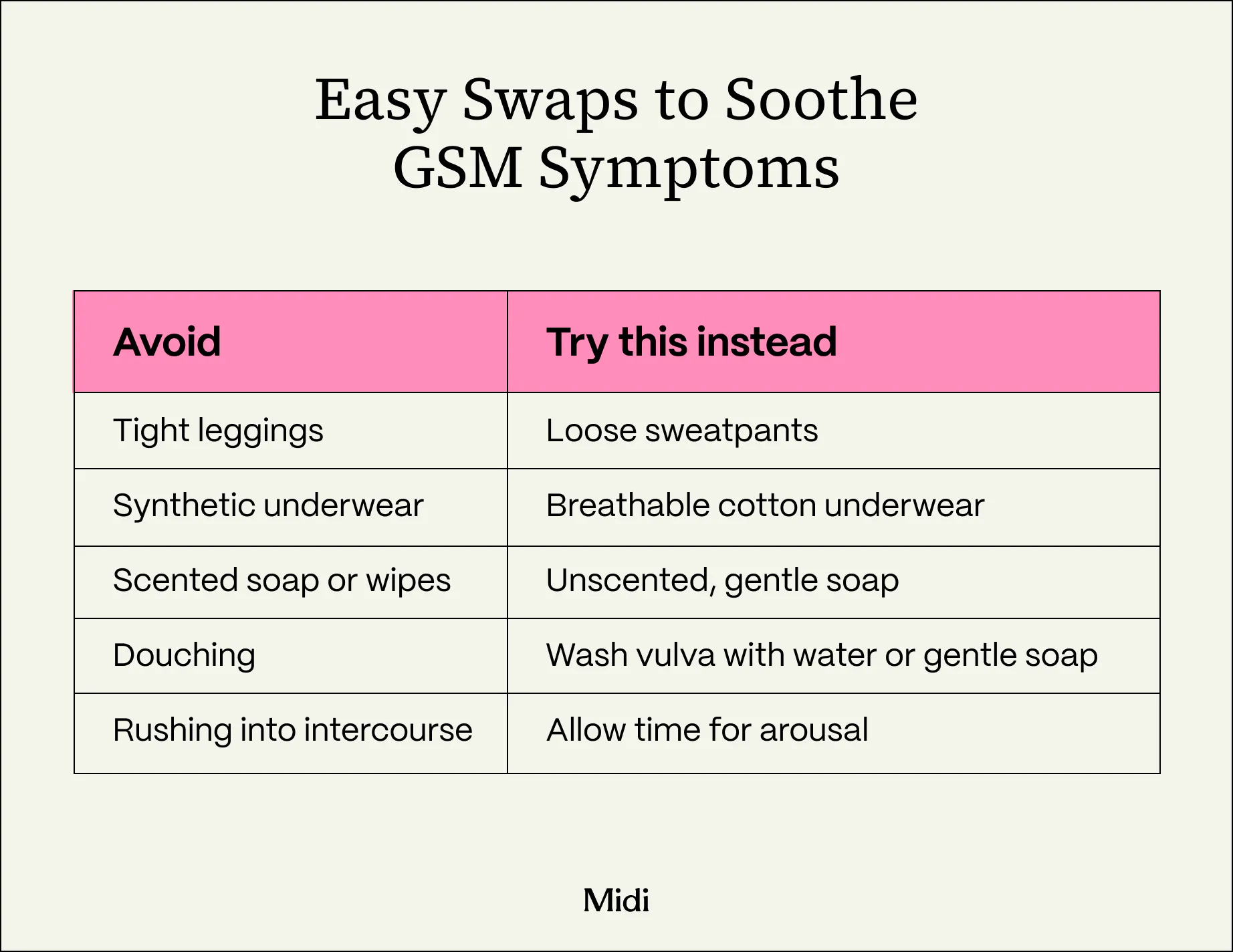
Feminine hygiene products and tight, restrictive clothing aren’t doing your vagina any favors. Here are a few tips to consider:
- Protect vaginal pH and skin: Steer clear of scented soaps, wipes, or harsh cleansers. Don’t douche, which can alter pH levels. Instead, go for mild, unscented soap (or just water) for external washing—vaginas don’t require rigorous internal cleansing.
- Rethink clothing choices: Stick with breathable, moisture-wicking cotton underwear. Change out of sweaty workout gear or swimsuits promptly to reduce itchiness. And avoid tight, non-breathable legwear that rubs you the wrong way.
- Tweak food options: To ease burning when peeing, stay well-hydrated and avoid spicy foods, artificial sweeteners, and fizzy drinks.
Sex, Intimacy, and Confidence: Practical Tips That Don’t Feel Awkward
GSM can affect your desire for sex—no surprise that you may well want to avoid something that’s super-uncomfortable or even painful. Some tips that may help:
- Communication with your partner is important. Try a simple explanation of what’s happening in your body, how it’s very common, and what you need to keep things physically comfortable.
- Use lubricant consistently and generously. Allow build-up time for arousal, too.
- Consider different positions. Look for ways to avoid painful friction.
Working With a Healthcare Professional: What to Ask at Your Visit
When discussing symptoms with your clinician, ask whether they sound like GSM. Tell your clinician:
- about all medications and supplements you take (because some commonly used medications, including those that treat depression, anxiety, colds, and allergies, can cause vaginal dryness)
- if you’ve recently had your ovaries removed (this thrusts you into surgical menopause), which can make GSM symptoms much more debilitating
Remember, ignoring perimenopausal or menopausal vaginal irritation or trying to brave your way through bladder leakage won’t make them go away. Your clinician can help you customize a care plan that will bring you relief.

When to Seek Care: Red Flags to Know
If you experience any of these symptoms, talk with your clinician:
- bleeding after menopause, persistent spotting, new bleeding patterns
- severe pelvic pain, fever, or back pain with urinary complaints
- new vulvar skin changes
- burning with urination that’s severe, sudden, or recurrent despite treatment
- new vulvar or vaginal symptoms after unprotected sex
Key Takeaways
- GSM is an umbrella term used to describe a group of bothersome vaginal, urinary, and sexual symptoms that comes about with declining levels of estrogen.
- It’s very common during perimenopause and menopause—as many as half of women in these life stages experience the symptoms.
- Symptoms of vaginal dryness are among the most common complaints and can cause discomfort and pain during exercise, sex, and just everyday movement.
- There are many treatments for GSM, including vaginal lubricants and moisturizers to ease sex, different forms of vaginal estrogen, and non-hormonal medications.
- A menopause-informed clinician, like those at Midi, is trained to help ease the symptoms of GSM.
Frequently Asked Questions (FAQs)
What are the symptoms of genitourinary syndrome in menopause?
The symptoms include vaginal dryness, urinary problems (like UTIs and burning during urination), and painful sex.
Is GSM permanent after menopause?
GSM is a chronic condition and it won’t resolve on its own, but it can be successfully treated and symptoms can be eased.
What are the female genitourinary disorders?
These are conditions that affect both the urinary system and the genital tract. They include GSM, UTIs, and yeast infections.
How do you treat genitourinary syndrome?
Treatment depends on the symptoms and can include hormonal and non-hormonal treatments as well as lubricants and vaginal moisturizers.
If you’re in perimenopause or menopause and want guidance from clinicians who specialize in women’s midlife health, book a virtual visit with Midi today.
Hormonal change is at the root of dozens of symptoms women experience in the years before and after their period stops.
Our trained menopause specialists can help you connect the dots to guide you towards safe, effective solutions.
Whether you need personalized guidance or a prescription routine to tackle symptoms—including vaginal dryness and irritation, brain fog, hot flashes, sleep trouble, mood swings, and weight gain—we’ve got you covered.
Midi’s mission is to revolutionize healthcare for women at midlife, wherever they live and whatever their health story. We believe that starts with education, to help all of us understand our always-changing bodies and health needs. Our core values guide everything we do, including standards that ensure the quality and trustworthiness of our content and editorial processes. We’re committed to providing information that is up-to-date, accurate, and relies on evidence-based research and peer-reviewed journals. For more details on our editorial process, see here.