
 Claudia Levine, MD
The body changes that hit in midlife can be tough and confusing to navigate, which is why perimenopause tests that promise fast and easy answers can feel so tempting. If an at-home hormone test could help you figure out what the heck is going on with your body, maybe at least then you’d be out of the annoying limbo stage and could start taking steps to feel better.
Alas, we wish we could say these at-home perimenopause tests will give you the info you’re looking for—but they’ll give you only part of the story. To help you understand what’s going on in your body, we’re delving into what a perimenopause test does, whether it can help, and what other information you should take into consideration.
If you're wondering whether you're in perimenopause, it's never a bad idea to share your symptoms, questions, or concerns with a healthcare professional, such as a Midi clinician, who can help give you answers and unique health guidance.
Once you reach midlife, changes in your body—like irregular periods and mood shifts that feel out of control—can leave you with a big question: "Am I in perimenopause?"
At-home perimenopause tests claim to give you the answer to that question, but the truth is, they can’t answer it definitively. Perimenopause is not a one-size-fits-all experience, and hormones can fluctuate so much that one test won’t give you the full picture.
Listen, we get why a perimenopause test is tempting. Perimenopause can be super confusing, so getting some sort of confirmation can make things feel less overwhelming and validate the symptoms you’re experiencing. While these tests can give you some info, they can’t give you a definitive diagnosis.
It’s important to consider the bigger picture. Track your symptoms and cycle changes; speak with a clinician (like one at Midi Health); and if you want to use testing, do it strategically to get a better idea of what’s going on with your body. Below, we’ll help you make a plan so that you can take steps to get the relief you need.
Perimenopause Test: What At-Home Tests Measure and What They’re Claiming
At-home perimenopause tests typically look at levels of hormones such as estrogen, progesterone, follicle-stimulating hormone (FSH), and luteinizing hormone (LH). The tests claim to be able to determine where you are in your menopause transition based on your results.
The problem is that hormone fluctuations are unpredictable—especially in perimenopause—and testing just once, or even a few times, can lead to unreliable results. In fact, you can get completely different results on different days.
Plus, different types of tests for perimenopause work differently and have varying levels of accuracy:
- Urine strips: These at-home tests are the most common; they use a small urine sample to determine levels of FSH (and sometimes estrogen and progesterone). FSH is high in menopause, but during perimenopause it may be low, high, or somewhere in between, depending on when it’s checked. These tests are considered 90% accurate—but keep in mind that they’re just measuring the FSH level in that specific moment, which can change minutes later!
- Finger-prick: These use the finger-prick method to collect a small blood sample, which is sent into a lab to be analyzed. It tracks levels of FSH, estradiol (a type of estrogen), and progesterone.
- Saliva tests: Hormone levels can also be detected in saliva, though this is considered the least reliable way to test. With some saliva tests, the sample is sent back to the company for testing.
- Hormone levels ordered by a healthcare professional: For this, you go to a lab and get bloodwork done, which is then sent in for testing. Some tests measure FSH, estradiol, progesterone, and LH.
Is There a Test for Perimenopause? How Clinicians Actually Diagnose It
There’s no official test for perimenopause—not even one that a clinician can give you. Clinicians generally diagnose based on information from the patient, including age, menstrual changes, symptom pattern, family history, and health history.
Perimenopause comes with some pretty common symptoms. If you have some or all of the ones below and you’re over age 40 or 45, it likely signals perimenopause:
- irregular menstrual cycles
- hot flashes and night sweats
- insomnia
- heart racing or pounding
- mood shifts, depression, or anxiety
- vaginal dryness
- trouble focusing or memory problems
- headaches
- urine leaks
A clinician may order hormone testing if you have atypical symptoms, you’re under age 40 and are experiencing symptoms, or they want to check for something else that may be causing your symptoms, such as a thyroid issue.

At-Home Hormone Test Accuracy: Why Results Can Be “True” But Not Helpful
Here’s the (slightly confusing) thing: Even when an at-home test accurately measures your FSH level, it doesn’t paint a full picture. Your hormones can vary greatly day to day and throughout your cycle, even if you’re not in perimenopause (but especially if you are).
Context is key. Say you’re experiencing typical perimenopause symptoms and you’re in your late 40s, but your test makes it look like you’re not in perimenopause. This could happen for several reasons. Maybe you tested on the wrong day of your cycle or your ovulation is very irregular. You’re getting only one snapshot of your health, when really, it’s a lot more complicated than that.
You can use an at-home perimenopause test to get one data point, as long as you don’t use that test alone to try to figure out your next steps. It’s not a diagnosis.
Test for Perimenopause: Which Hormones Are Commonly Included and What They Can Suggest
At-home perimenopause tests look at the levels of one or all of the hormones below:
- FSH: Produced by the pituitary gland in your brain, FSH has the job of stimulating ovarian follicles so that they make sufficient estrogen to release an egg. As you get older, FSH levels start to rise as estrogen levels decline, to try and bump up estrogen. During perimenopause, FSH levels can fluctuate, and by menopause levels are quite high. But high levels can also indicate thyroid disease or polycystic ovary syndrome (PCOS, now officially called polyendocrine metabolic ovarian syndrome), an ovarian disorder. So even if a test shows high FSH levels, it doesn’t definitively point to perimenopause.
- Estradiol: The primary form of estrogen when it comes to reproduction, estradiol will typically drop considerably or fluctuate during perimenopause, depending on where you are in your menstrual cycle. In menopause, the production of the hormone drops significantly. But lower levels of estradiol also can also signal an autoimmune disease or even ovarian cancer.
- Progesterone: This hormone helps prep the lining of your uterus for a fertilized egg to implant and grow, and it supports pregnancy. Progesterone levels rise after ovulation, becoming more erratic during perimenopause. And in menopause, when ovulation has stopped completely, progesterone levels are consistently low.
- LH: This hormone is secreted from the pituitary gland and stimulates changes in your ovaries, like ovulation and progesterone production. LH levels will typically increase during perimenopause, but a rise can also indicate PCOS.
- Thyroid markers: Some at-home tests look for these levels, since thyroid issues can have symptoms similar to some of those for perimenopause.
So while these at-home hormone tests may give you a momentary snapshot of your hormone levels at that moment, none can definitively determine whether you’re in perimenopause.
How to Test for Perimenopause at Home Without Wasting Money
If you’re looking for some baseline context on what’s going on with your hormones, you might find an at-home test useful, despite the limitations. Keep these tips in mind:
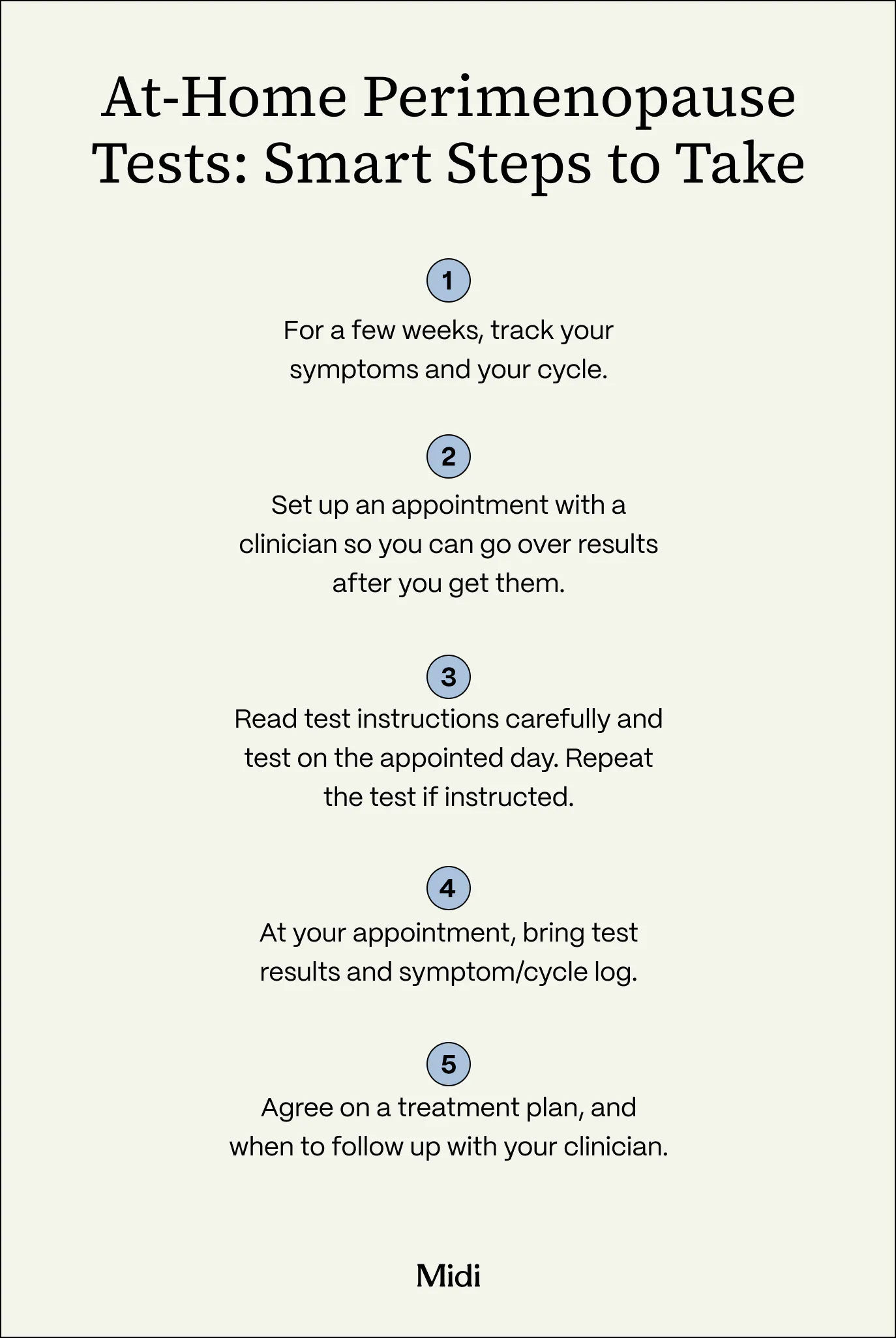
- Before you test, make a plan to follow up with a clinician: This is key. When you get the results, a healthcare professional (like a Midi clinician) can help you understand them, and go over your symptoms and your family and personal health history.
- Document your symptoms and cycle pattern before you test: Take a few weeks to keep track of what’s going on with your body. Document your symptoms each day, as well as your cycle pattern, especially if it’s irregular.
- Try to time the test to your cycle: Some tests recommend testing on day 2 or 3 of your menstrual cycle, while others recommend day 21. Make sure to closely follow the instructions on the test you choose.
- Choose the panel that works for you: If you or your clinician think there may be something else going on besides perimenopause, especially if you’re under age 40, look for a test that might help rule out other issues.
- Use your results in the smartest way possible: Remember, these at-home tests alone cannot determine perimenopause, so don’t self-diagnose. Instead, use them as a path forward by working with a clinician.
At-Home Perimenopause Test vs. Lab Testing Ordered by a Clinician
At-home perimenopause tests and clinician-ordered lab tests aren’t the same—and, generally, clinician-ordered tests are thought to be the more accurate option. For one thing, when you do a urine sample or finger-prick at home on your own (with possibly no medical experience), there’s more room for error, as opposed to the more controlled environment of a lab.
Another factor: When you read your own test results, you may not know what to look for or what everything means. A clinician can go over it with you and clarify the findings. Plus, your clinician is better able to rule out certain results based on your symptoms, history, and age.
Repeated testing is a consideration as well. Some at-home tests do ask for repeated tests, but others give results based only on one test. During this life stage, when hormones can fluctuate so much, repeated testing may give you a better idea of your actual levels.
There’s nothing wrong with testing if you simply want to see more of your own health data. But if a clinician feels certain that all signs are pointing to perimenopause, you may want to skip it and head straight to talking about how to best treat your symptoms.
True Stories Of Transformation
What At-Home Tests Don’t Tell You (But You Still Need to Know)
There are things that an at-home test can’t tell you. For example, this test:
- can’t explain why you’re experiencing heavy bleeding or irregular bleeding patterns
- can’t get into your risk of anemia, fibroids, polyps, or other gynecologic issues
- can’t show you your cardiovascular or metabolic risk factors
- can’t come up with a treatment plan for your symptoms
- can’t tell you if you’re pregnant, which is still possible during perimenopause (if you suspect that could be what’s going on, your first step should be a pregnancy test)
Treatment Options: What to Do if You Think You’re in Perimenopause
There’s no one magic treatment for perimenopause; it’s unpredictable and its impact is individual. Monitor your symptoms for several weeks, then discuss options with a healthcare professional (such as a Midi clinician), keeping in mind these tips:
Start with your most disruptive symptom
What’s bothering you the most? Insomnia? Hot flashes or mood shifts? Start with the symptom(s) giving you the most trouble and ask your clinician what you can do to make it less intense.
Discuss hormone therapy options
Hormone therapy—also called hormone replacement therapy (HRT)—can help increase hormones like estrogen and progesterone in your body. This may help with common symptoms like hot flashes and mood shifts; in fact, HRT is widely considered the most effective treatment for easing some of the most significant perimenopause symptoms. One 2023 review found that hormone therapy may address 70% to 90% of perimenopausal symptoms.
Vaginal estrogen can decrease vaginal dryness, irritation, and discomfort. If you have these symptoms during perimenopause, your clinician may prescribe vaginal estrogen cream, suppositories, or a ring instead of, or along with, systemic hormones.
Still, HRT isn't right for all women, so you and your clinician can discuss whether it’s safe and appropriate for you, depending on your symptoms and health history.
Consider non-hormonal options
Consult your clinician about possible non-hormonal options that may help with symptoms. This could include:
- Antidepressants: to help with mood shifts, depression, or anxiety
- Other medications: such as fezolinetant to help with hot flashes, oxybutynin for bladder issues, or gabapentin for hot flashes and insomnia
- Birth control pills: to help stabilize hormone levels and ease symptoms
Change up some lifestyle habits
These changes can make a difference in your symptoms:
- Eat a healthy diet: Focus on fruits, vegetables, whole grains, lean proteins, and healthy fats.
- Exercise regularly: Choose strength training and cardio workouts that you like doing (which makes it easier to keep it up).
- Work on your sleep routine: Set a regular sleep-wake schedule, and incorporate calming strategies like meditation.
- Help ease hot flashes: Dress in layers and keep a mini fan on hand.
- Limit alcohol and caffeine: This may help reduce hot flashes and let you sleep better.
- Manage stress: You can do this by working out, practicing yoga or meditation, setting boundaries, or speaking with a therapist.

Working With a Healthcare Professional: How to Discuss Test Results (and Get Real Answers)
If you’ve decided to try a perimenopause test, here’s what to keep in mind when it’s time to talk with your clinician about your results:
- Be prepared with info: As well as your test results, have on hand the symptoms you’ve been tracking and any menstrual cycle changes you’ve noted. Also have a list of any medications and supplements you take regularly.
- Discuss your top priorities and safety concerns: Talk with your clinician about your family and personal health history, and ask what you should be most concerned about.
- Ask about repeat testing and treatment: Talk about whether you should test again to get more data, and if that’s not needed, discuss your treatment options.
- Agree on a follow-up plan: Discuss what improvements you should look for, how long it should take to notice them, and when you should speak with your clinician again.
When to Seek Care (Red Flags)
Perimenopause symptoms are normal (and expected), but in some situations, you should seek care right away. If you experience any of the symptoms below, reach out to a clinician as soon as possible:
- very heavy bleeding, bleeding between periods, or bleeding after sex
- new severe headaches, chest pain, fainting, or severe palpitations (seek emergency care)
- symptoms that are rapidly worsening or significantly impairing daily functioning
- signs of anemia (severe fatigue, dizziness) or persistent shortness of breath
Key Takeaways
- At-home perimenopause testing can help you with baseline health data, but it can’t give you a definitive answer on whether you’re in perimenopause.
- Perimenopause tests can tell you more information about hormone levels, but this is not sufficient to diagnose perimenopause because hormones can fluctuate wildly during this stage of life. You also need to take into account symptoms, age, family history, and health conditions.
- If you do want to take a test to get more information on your health, your best bet is to follow it up with a discussion with a clinician, who can help you understand results, rule out other possibilities, and form a treatment plan.
- A perimenopause test isn’t necessary in order to determine perimenopause.
Frequently Asked Questions (FAQs)
What tests confirm perimenopause?
There is no one test that can confirm you’re in perimenopause. At-home perimenopause tests can tell you the levels of your hormones at the time you tested, but hormones fluctuate, and even lab tests don’t give you a full picture.
How do you confirm you have perimenopause?
Clinicians will typically determine whether you’re in perimenopause based on your age, symptoms, and family and medical history. They may recommend testing if they suspect another health issue might be at play or if you’re younger than 40.
What are the first signs of perimenopause starting?
First symptoms generally include irregular menstrual cycle or missed periods, periods that are heavier or lighter than usual, mood shifts, hot flashes, night sweats, insomnia, vaginal dryness, and urinary issues.
What can be mistaken for perimenopause?
There are other health conditions that could be confused with perimenopause, especially if you’re over age 40. These include hypothyroidism, autoimmune conditions, and pregnancy.
How can I test for perimenopause at home?
At-home perimenopause tests vary. Some require a urine sample, some require a finger-prick for a blood sample, and some need saliva. For others, you go to a lab to get a comprehensive bloodwork panel.
If you’re in perimenopause or menopause and want guidance from clinicians who specialize in women’s midlife health, book a virtual visit with Midi today.
Hormonal change is at the root of dozens of symptoms women experience in the years before and after their period stops.
Our trained menopause specialists can help you connect the dots to guide you towards safe, effective solutions.
Whether you need personalized guidance or a prescription routine to tackle symptoms—including brain fog, hot flashes, sleep trouble, mood swings, and weight gain—we’ve got you covered. Learn more here.
Midi’s mission is to revolutionize healthcare for women at midlife, wherever they live and whatever their health story. We believe that starts with education, to help all of us understand our always-changing bodies and health needs. Our core values guide everything we do, including standards that ensure the quality and trustworthiness of our content and editorial processes. We’re committed to providing information that is up-to-date, accurate, and relies on evidence-based research and peer-reviewed journals. For more details on our editorial process, see here.