


Disjointed sleep and fuzzy thoughts are two of life’s everyday disruptions for many perimenopausal and menopausal women. No surprise, then, that the emerging data on magnesium L-threonate benefits may sound appealing. The supplement is rumored to help with both sleep issues and brain fog, two concerns that Midi Health clinicians hear about time and again from their patients.
But the available studies on magnesium L-threonate supplements are small so far. Plus, both sleep and brain fog can be related to many different issues—some that have to do with the menopause transition and some that don’t. We’ll give you info on magnesium L-threonate, as well as advice to help you get the shut-eye you need and shake off that mental fog.
Raise your hand if you’ve had one too many sweaty nights of disrupted sleep and one too many days where you’ve forgotten your keys or your best friend’s birthday. Alas, sleep issues and brain fog are a normal part of life for many midlife women—which is why data around magnesium L-threonate benefits is sparking a lot of interest.
With all the chatter around this form of magnesium and its potential to help with both sleep and next-day focus, you may wonder: Is it a midlife magic bullet? And is it better than other forms of magnesium that are also mentioned as sleep savers?
The limited data on magnesium L-threonate is promising, although human evidence isn’t yet extensive. To help you determine whether this supplement might be worth trying, we’ll break down what you need to know about magnesium L-threonate benefits, how it’s different from other magnesium forms, and how it affects sleep and brain fog.
Magnesium L-Threonate Benefits: What May Matter Most in Midlife
Any route to a better night’s sleep and a less fuzzy brain would be a big boost for many midlife women, who may be struggling with moods and daytime functioning during menopause. There’s research that higher magnesium in general has been associated with better and longer sleep—and there is some evidence that magnesium L-threonate may help.
What makes magnesium L-threonate stand out from other forms of magnesium is that it easily crosses the blood-brain barrier—meaning, it’s better able to raise magnesium levels in the brain.
A recent placebo-controlled study found that magnesium threonate improved participants’ sleep quality (especially REM sleep), mood, energy, alertness, daily activity, and productivity. This was measured by participants’ own reports, as well as by the sleep info reported by the Oura tracking rings that they wore.
It’s important to note this was a small study, with 80 participants, and only lasted three weeks. Plus, it was funded by the supplement industry, and it included both women and men, so wasn’t done specifically with menopause symptoms in mind.
Some of the other research on magnesium L-threonate was done on animals, so the findings don’t necessarily apply to humans.

What Makes Magnesium L-Threonate Different From Other Forms
Different magnesium supplements tackle different issues. (So when one type is studied, the research doesn’t necessarily transfer to the others.) Magnesium L-threonate is being looked at closely because the L-threonate molecule helps the magnesium pass through the blood-brain barrier.
Think of the blood-brain barrier as a security guard to the brain. Not everything that flows through the blood is allowed through the barrier, but L-threonate has clearance to shepherd magnesium into the brain.
This means it can affect brain function more efficiently than other types, without simply being absorbed by the rest of the body. And since magnesium L-threonate is more easily absorbed by the brain, the hope is that there’s more potential for it to have an impact on sleep and cognition.
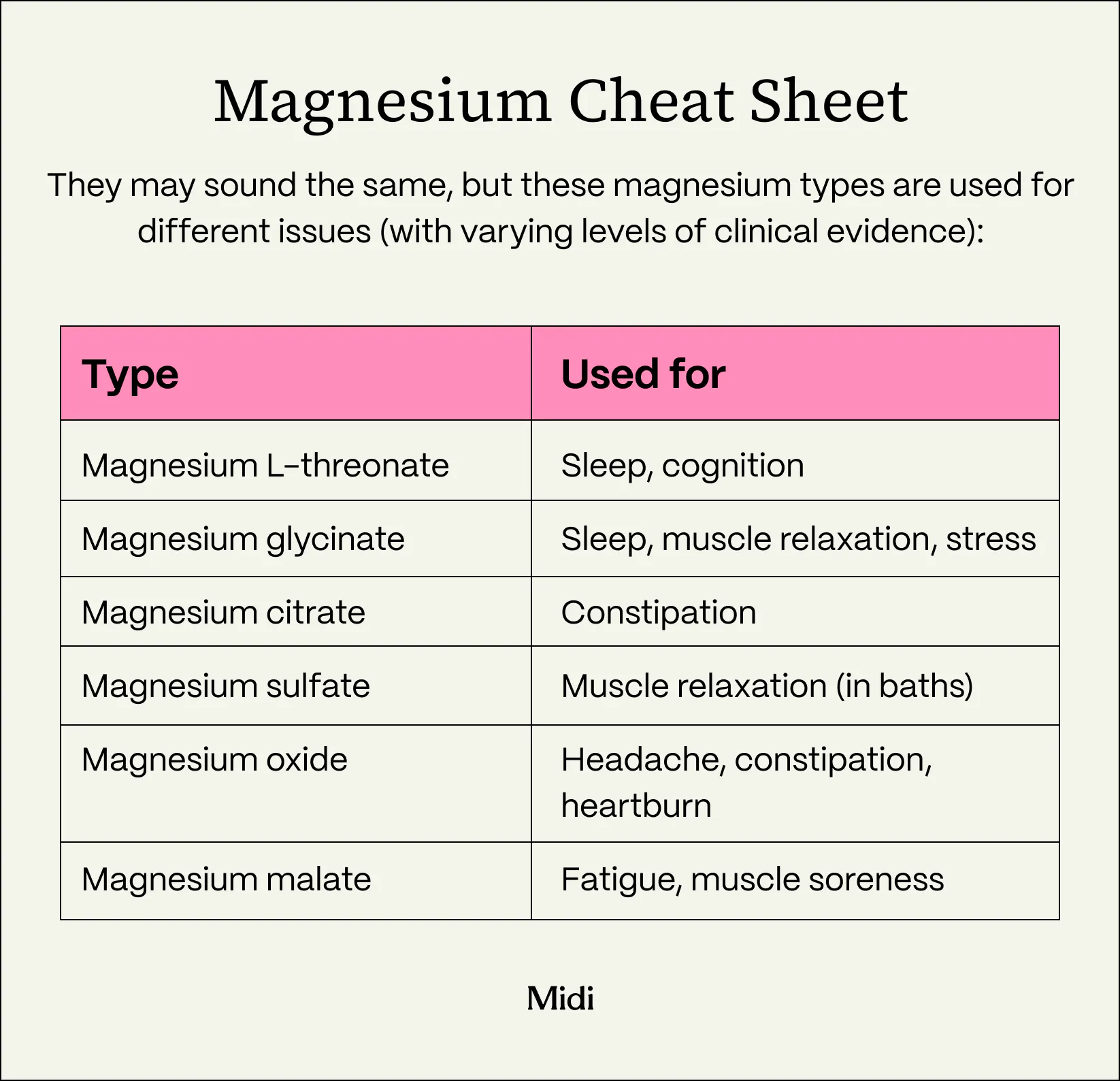
Other popular forms of magnesium include:
- Magnesium glycinate: commonly used for sleep, muscle relaxation, and stress, and known to be easy on the stomach
- Magnesium citrate: magnesium combined with citric acid; well absorbed by the body and may be used occasionally as a laxative for constipation
- Magnesium sulfate: the active ingredient in Epsom salts, which is generally used in baths for muscle relaxation and in certain medical treatments
- Magnesium oxide: may be helpful for headaches or migraine prevention, some evidence shows; also used for occasional constipation or heartburn
- Magnesium malate: sometimes used for fatigue, muscle soreness, and recovery, though evidence on its effectiveness is very thin
What Success Looks and Feels Like
Sleep, Brain Fog, and Stress: Where the Evidence Is Stronger vs. Weaker
The study mentioned above gives some fairly good data about the impact of magnesium L-threonate on sleep (though it’s reliability is limited). Participants who took 1 gram (g) per day reported that they got deeper and more restorative rest than people in the placebo group. Their Oura rings also gave positive sleep metrics: They spent more time in restorative deep sleep and had better REM sleep (the stage during which memories are consolidated).
The participants who took the supplement also reported feeling sharper the next day, and their Oura rings showed that they were more active. But because the study included only 80 people and lasted only 3 weeks, more definitive research is needed.
Another study (also funded by the supplement industry) included 100 participants who took either 2 g of magnesium L-threonate per day or a placebo. Those who took the supplement didn’t show an improvement in their sleep—but they reported that they felt better and sharper during the day, as well as less affected by poor sleep. The researchers used cognitive tests to measure things like their memory, attention, and processing speed, and the people who took the supplement showed improvements in all of those areas. Again, larger human studies are needed to confirm this research.
The jury is still out on broader claims relating to anxiety, depression, ADHD, pain, and migraine. Getting a better night’s sleep in general could theoretically improve some of these, but it’s hard to link that directly to a single supplement at this point.
The takeaway: It may be worth considering taking a magnesium L-threonate supplement if sleep issues and next-day brain fog are concerns for you. We’ll know better when there’s more data about how much to take and whom it could help.
For women in midlife, many factors can have an impact on sleep and brain fog. A menopause-informed clinician, like one at Midi, can be a big help in figuring out the best steps for you.

Which Magnesium Is Good for Sleep? Magnesium Glycinate vs. L-Threonate
Both magnesium L-threonate and magnesium glycinate can have an impact on sleep, evidence seems to show, and both are fairly well tolerated.
There isn’t necessarily a better choice, and head-to-head data on the two supplements is limited. Also, many of the earlier magnesium studies don’t specify which type of magnesium was used, so it can be hard to see how that research may apply to each type.
That said, to recap some details:
Magnesium glycinate: Research has shown that it may lower anxiety over time, and some evidence found that it has a calming effect on the body that may make it easier to fall asleep.
Magnesium L-threonate: Early research shows it may help you get more restful sleep, as well as help with next-day brain fog, mental fatigue, or alertness.
How to Choose a Magnesium Threonate Supplement
With any supplements, look for a brand that uses third-party testing or recognizable quality certification. For this supplement, you’ll want to look for clear labeling that shows both total dosage and elemental magnesium. (The amount of elemental magnesium may be less than with other magnesium forms, but that’s to be expected with this type.)
Check out the serving size—with some products, you need to take more than 1 capsule to get to the amount listed. Note that magnesium L-threonate is generally more expensive than other forms of magnesium. You’ll often see it marketed as Magtein, a patented version of the supplement.
How and When to Take It
The key to seeing results from taking a magnesium threonate supplement is consistency. If you miss a dose here or there, that’s OK, but you’ll get the best results by taking it as consistently as possible. Some more guidance:
- Consumer guidance is varied on dosing, but in one sleep trial, the dosage used was 1 g daily, taken before bedtime. Another study used 2000 mg.
- It may not help immediately—in that sleep trial, participants began to see a difference a week or two after the trial began.
- For sleep, people usually take it before bed. People using it for cognition may split their dose between morning and evening.
- Don’t take more than recommended, especially if you’re using other magnesium products, to avoid side effects.
Magnesium L-Threonate Side Effects and Safety
Magnesium L-threonate is safe for the general population and seems to be well-tolerated. Plus, studies haven’t found significant adverse effects. Based on potential side effects of magnesium supplements in general, some mild effects could include:
- nausea
- diarrhea
- abdominal cramping
- upset stomach
People with kidney disease should consult their physician before starting any form of magnesium. Damaged kidneys can’t excrete magnesium, which can lead to a buildup of the mineral in the body.
If you’re on antibiotics, diuretics, bisphosphonates, proton pump inhibitors, or some mineral supplements, it’s also a good idea to talk with your doctor first, because magnesium may affect how some meds are absorbed or have an impact on mineral balance. And if you’re pregnant or breastfeeding, talk with your clinician before taking any supplement.
When to Think Beyond Supplements and Talk With a Clinician
A lot of things can get in the way of a good night’s sleep. It may be as simple as an overly warm room or light coming through your curtains—but it can also be due to stress, perimenopause symptoms, anxiety, depression, sleep apnea, restless legs, medication side effects, or low magnesium (or any combo of those!).
The point is, to properly tackle sleep issues, it’s important to get to the root causes. A Midi clinician can help you evaluate your situation and come up with solutions that work best for you. If your issues are due in part to perimenopause or menopause symptoms, your clinician can recommend a range of treatments and lifestyle shifts that may help.
It’s especially important to evaluate what’s going on when your insomnia is persistent, getting worse, or tied to snoring. Mention to your clinician if you’re experiencing:
- gasping during sleep
- severe daytime sleepiness
- mood changes
- major memory concerns
When you meet with a clinician, bring a list of all supplements and medications you take (along with dosages), as well as notes on when and how often you have symptoms. If you can, keep a log of symptoms for a week or two before your appointment—that will help your clinician get you on the path to more restful nights and sharper, clearer days.
Key Takeaways
- Magnesium L-threonate shows potential for improving sleep quality and next-day mental alertness. Human studies are limited and industry-funded, but both objective and subjective data are promising.
- This form of magnesium is better able to cross the blood-brain barrier, meaning more magnesium gets to the brain.
- Many things can affect sleep, and magnesium supplements won’t help with all issues. A menopause-trained clinician can help you sort out your symptoms.
- It’s especially important to consult a clinician if sleep issues are persistent, worsening, or disruptive.
Frequently Asked Questions (FAQs)
Which is better, magnesium glycinate or L-threonate?
One isn’t necessarily a better choice than the other. There’s evidence that magnesium glycinate can calm the body and relax muscles, which may help you fall asleep. The research on magnesium L- threonate shows promise for sleep quality and next day alertness.
Should you take magnesium threonate every day?
If you are taking magnesium threonate for cognitive function, sleep, or memory, it’s best to take it consistently every day.
Who should not take magnesium L-threonate?
People with kidney disease should not take magnesium L-threonate. Pregnant and breastfeeding women should consult their physician before taking it. It’s always smart to talk with your clinician when starting any new supplement.
What are the 7 signs your body needs magnesium?
Signs of low magnesium are hard to identify, since the symptoms can be similar to other health issues. Seven signs that may be linked to low magnesium include:
- fatigue
- muscle cramps
- restless sleep
- brain fog
- heart palpitations
- irritability or anxiety
- headaches
Does magnesium L-threonate make you sleepy?
Magnesium L-threonate is not a sedative, but because it may relax you, you may feel sleepy when you take it.
If you’re in perimenopause or menopause and want guidance from clinicians who specialize in women’s midlife health, book a virtual visit with Midi today.
Hormonal change is at the root of dozens of symptoms women experience in the years before and after their period stops.
Our trained menopause specialists can help you connect the dots to guide you towards safe, effective solutions.
Whether you need personalized guidance or a prescription routine to tackle symptoms—including vaginal dryness and irritation, brain fog, hot flashes, sleep trouble, mood swings, and weight gain—we’ve got you covered.
Midi’s mission is to revolutionize healthcare for women at midlife, wherever they live and whatever their health story. We believe that starts with education, to help all of us understand our always-changing bodies and health needs. Our core values guide everything we do, including standards that ensure the quality and trustworthiness of our content and editorial processes. We’re committed to providing information that is up-to-date, accurate, and relies on evidence-based research and peer-reviewed journals. For more details on our editorial process, see here.