

Thousands of women across the United States are dealing with an estrogen patch shortage as manufacturers struggle to keep up with demand. As a result, women have had to switch pharmacies or brands, with some being forced to stop hormone replacement therapy (HRT) entirely. In fact, in a Midi Health survey polling nearly 8,000 women across the country, 44% of respondents reported difficulty filling their estrogen patch prescriptions. Of those women, 34% feel the estrogen shortage has significantly impacted their well-being. Fortunately, there are steps you can take to avoid gaps in your care. Read on for what you need to know about the estradiol patch shortage and how Midi clinicians can help you continue your care.
Across the nation, thousands of women are dealing with the repercussions of an estrogen patch shortage that’s endured for months.
As more and more women rely on hormone therapy to relieve perimenopause and menopause symptoms, manufacturers have struggled to keep up. The impacts are noticeable, to say the least: Nearly 1 in 2 women has had difficulty filling an estrogen patch prescription, according to a Midi Health survey from May polling nearly 8,000 women from 49 states.
Those numbers have likely since gone up. As of early September, there are 17 estrogen-patch formulations impacted by the shortage, according to data from the American Society of Health-System Pharmacists. That number is nearly double the amount from earlier in the year.
This news is undoubtedly distressing, but fortunately, there are still ways to get the care you need. Keep reading to learn why the estrogen patch shortage is happening, how it’s affecting women, and what Midi is doing to address this growing issue.
What Is the Estrogen Patch Shortage, and Why Is It Happening?
The estrogen patch shortage (also referred to as the estradiol patch shortage or HRT shortage) refers to the ongoing decline in the supply of prescription estrogen patches. While the FDA doesn’t currently recognize this as a formal shortage, women have reported difficulty filling their prescriptions and getting the care they need for months.
This is a big deal. Estrogen patches are one of the most commonly prescribed forms of hormone replacement therapy (HRT, now commonly referred to as menopause hormone therapy, or MHT). HRT is used to help ease some of the more significant perimenopause and menopause symptoms, such as hot flashes, night sweats, and osteopenia, among others. While HRT is available in many forms, estrogen patches may have milder side effects than other treatment methods, such as estrogen pills. What’s more, patches offer simple dosing options, tout a lower disease risk than pills, and are simply a more convenient choice for many women.
Unfortunately, this isn’t the first time such a shortage has occurred.
“These estrogen patch shortages have been going on for a couple years intermittently,” said Midi’s Chief Medical Officer Kathleen Jordan, MD. It all boils down to supply-chain issues: Manufacturers simply don’t have the systems in place to meet a climbing demand.
The FDA officially removed the black box warning from many HRT products for menopause last year, and as more women start HRT earlier and stay on it longer, manufacturers haven’t kept up. As a result, many women are experiencing lapses in their care.
Different forms of HRT are included in the shortage, such as oral estrogen and oral progesterone, but women are largely experiencing difficulty accessing estrogen patches.
“The patch shortage has continued, and women are still struggling to fill their prescriptions for estrogen patches throughout the nation,” Dr. Jordan says.
While there’s no official end date to the shortage in sight, progress is being made. In May, leaders from the Midi team sat down with senior officials from the FDA for a listening session on the estrogen patch shortage.
Those FDA officials are already working to expedite approvals for new manufacturing lines, and the team discussed formal recognition of this shortage, greater flexibility around alternatives, and incentives for manufacturers to expand capacity.
What's the latest update?
On September 3, the FDA shared that it's working with all six estradiol patch manufacturers to increase supply. The administration said it's offering assistance to manufacturers who want to scale production by fast-tracking submissions to expand supply.
Estrogen patch manufacturers are taking steps to increase availability, too, such as:
- adding manufacturing shifts
- expanding production capacity
- increasing batch sizes
- adding specialized equipment and manufacturing lines
- prioritizing production of estradiol patches
While progress is being made, it's clear that shortages continue to have real impacts on women throughout the nation.
How the Estradiol Shortage Is Impacting Women
The estrogen patch shortage is affecting thousands of women nationwide:
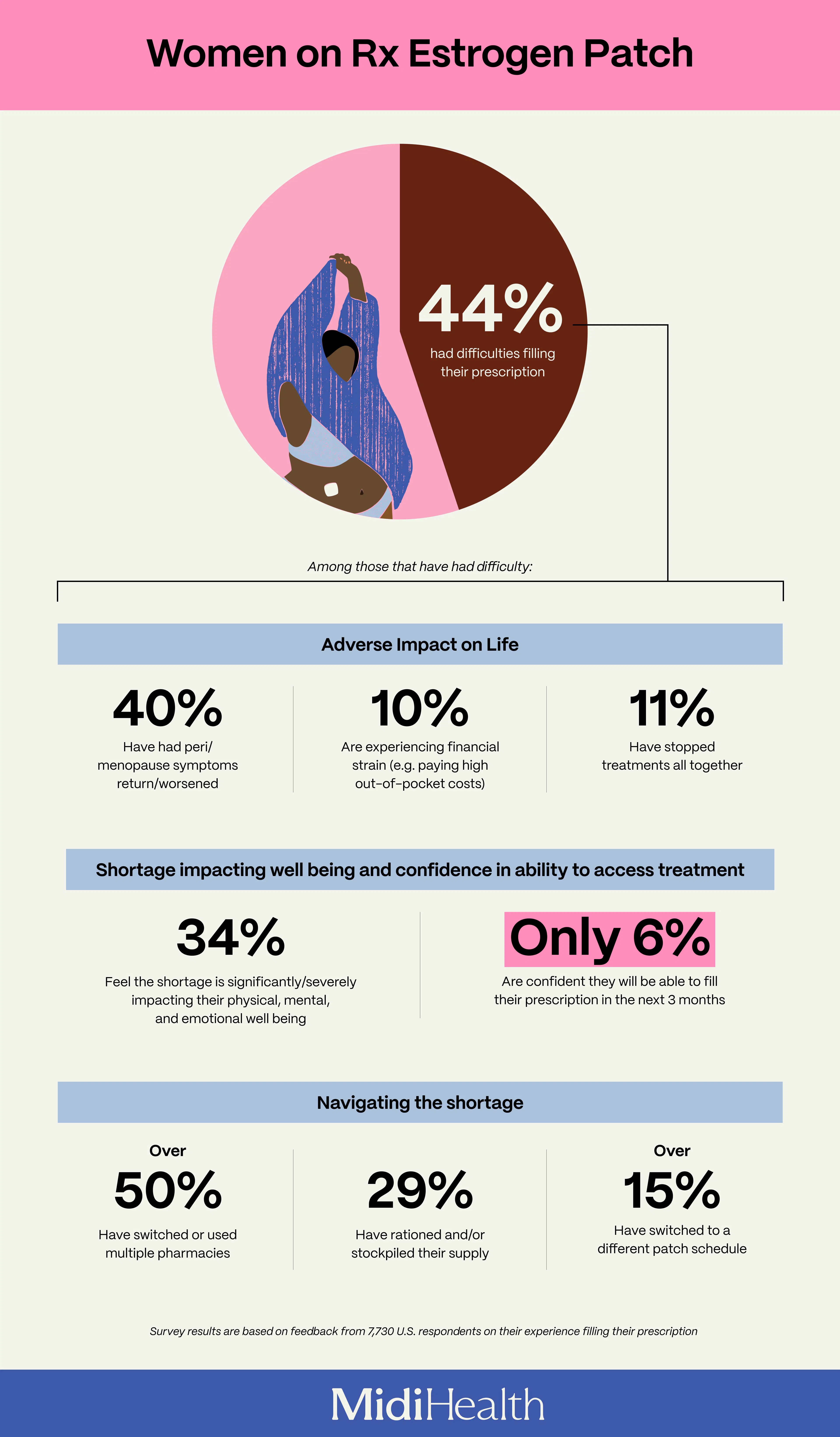
- Of the nearly 8,000 women that Midi surveyed, nearly half (44%) reported difficulties filling their estrogen patch prescription this year.
- Among that group, only 6% feel confident they’ll be able to fill it in the next 3 months.
This gap in coverage has forced women to navigate their care in new ways. Of the women who've had trouble filling their prescriptions:
- More than half (55%) changed their pharmacy to fill their medication.
- 29% skipped or cut doses or stockpiled their supply to prepare for delays.
- 17% switched to a different patch schedule (e.g., to a weekly patch).
- 1 in 10 women (10%) have had to pay out of pocket for an alternative formulation or to get estrogen from another source.
- 7% changed their medication type, switching from the patch to a cream, gel, or pill.
- 11% had to forgo hormone therapy entirely because they couldn’t fill their prescriptions.
“When I recently tried to refill my prescription, my pharmacy told me that they had run out,” says Jennifer Maldonado, age 47, a Midi patient and ambassador. “This has created real stress in my daily life. Instead of feeling secure and managing my health, I’m left feeling anxious.”
This shortage has had unacceptable effects on women. Of those who've had difficulty filling their prescriptions:
- More than a third (34%) feel that the estrogen patch shortage has severely impacted their physical, mental, and emotional well-being.
- 4 in 10 women (40%) say their symptoms have returned or worsened.
- 26% have lost sleep worrying about not being able to fill their prescription.
- 13% have been less productive at work, and 4% have had to miss or take time off work.
- 11% have reduced their exercise or physical activity.
- 10% say it’s caused financial strain.
- 5% have had to cancel social plans, while 3% have had to miss family commitments.
“When you miss a dose or you have to switch something that was actually working, you feel it,” says Midi patient and ambassador Lea Roman, age 49. “It affects your mood, your sleep, your focus—your entire day, honestly.”
The estrogen patch shortage isn’t relegated to only a handful of areas, either: Women across the nation are experiencing gaps in care. The states with the highest incidence of difficulty filling their estrogen patch prescriptions include California (58%), Massachusetts (57%), and Virginia (51%). Even in less impacted states, such as Texas, the shortage has impacted nearly a third (31%) of women prescribed the estrogen patch.
What to Do if You Can’t Refill Your Estrogen Patch Prescription
If you’re having trouble getting your estrogen patch prescription filled, know that options are available for you to get the care you need. If you’re a Midi patient, message your clinician and mention HRT to explore what options are available to you (or if you’re new to Midi, you can book a visit here).

In the meantime, here are a few steps you can take to prevent gaps in your care.
1. Refill Early and Ask About 90-Day Supplies
If your insurance allows, get ahead of care interruptions by refilling your prescription up to 2 weeks in advance. You can also request 90-day supplies to better prepare for stock uncertainties and reduce your number of pharmacy visits.
Just make sure your insurance gives you the green light first, and ask a healthcare professional, like a Midi clinician, to update your prescription.
“It’s always a good idea to try to fill your prescriptions early so that we have time to move the prescriptions around and help support you,” Dr. Jordan says.
2. Ask Your Pharmacy if They Have a Different Brand in Stock
If your pharmacy doesn’t have your go-to estrogen patch brand, they may at least have a similar option available.
“They can switch brands and still fill your prescription,” Dr. Jordan says.
3. Check if Another Pharmacy Has Your Prescription Available
If your preferred pharmacy is impacted by the estrogen shortage and you’re unable to refill your prescription, try calling different pharmacies in your area to see whether they have your medication in stock.
“Your pharmacy can transfer the prescription electronically, sometimes solving the issue,” Dr. Jordan says.
4. Talk With Your Clinician About Alternative Formulations
Unfortunately, some entire regions have been hit by the estrogen patch shortage, possibly preventing you from refilling your prescription anywhere near you. This may feel scary or unsettling, but know that there are ways to receive the hormone therapy you need in the meantime.
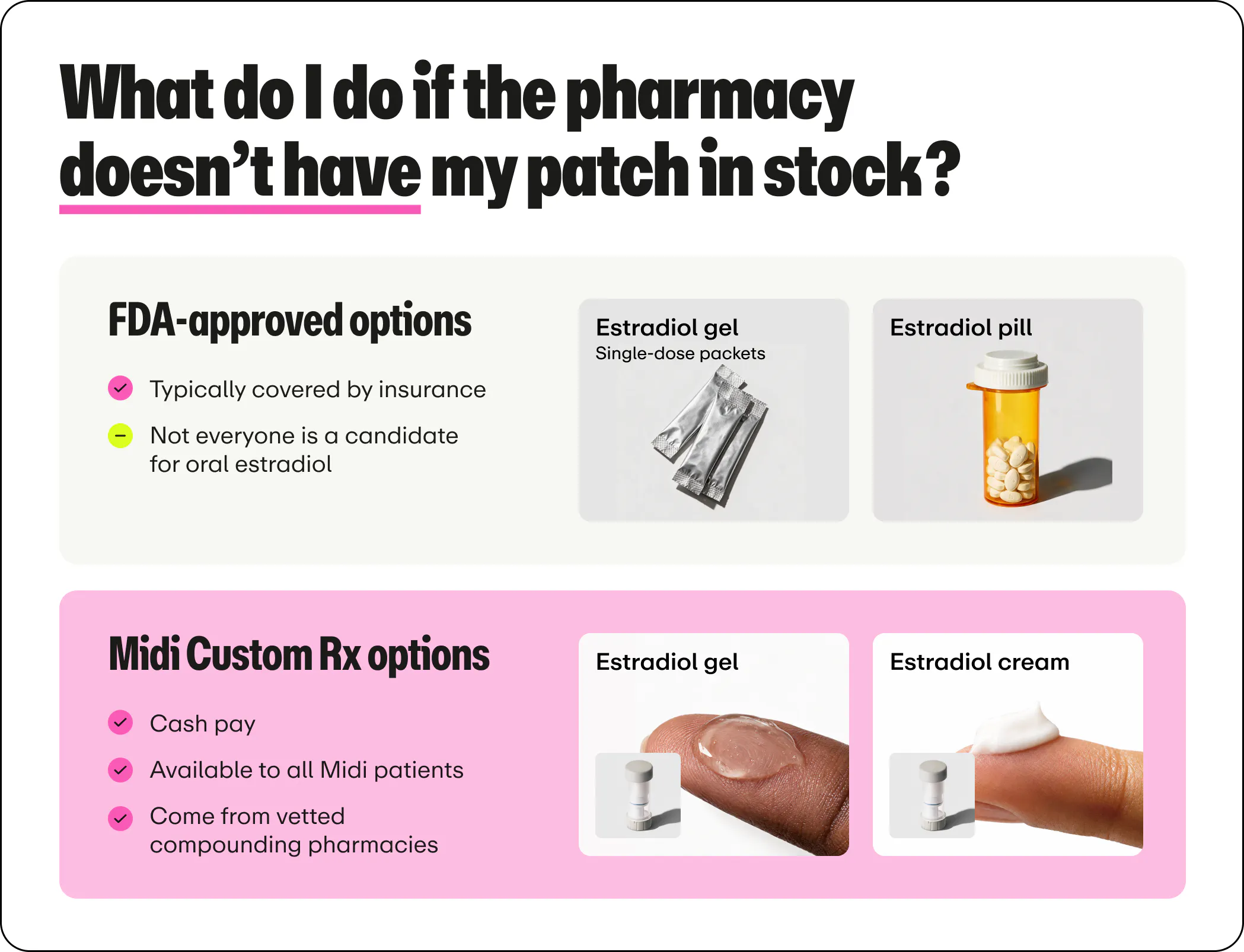
You can discuss a couple options with your clinician to ensure you have uninterrupted care, including:
- Different patch formulations: “We can try to put two smaller patches together or go to a once-weekly patch from a twice-weekly patch,” Dr. Jordan says. She just recommends asking your pharmacy whether they have those patch options in stock before going that route.
- Non-patch formulations: To bridge your care, your clinician can temporarily switch you to non-patch formulations, as “the shortages are primarily with the patches,” Dr. Jordan says. At Midi, for example, “we’ve worked with a compounding pharmacy to create an estrogen gel, an estrogen cream, and a progesterone capsule,” she says.* Just be aware that some options may not be covered by your insurance.
As always, remember that a healthcare professional, like a Midi clinician, can help map out the best route for you and your health.
“If you are experiencing the shortages, know that your Midi clinician is there for you and we can come up with alternatives,” Dr. Jordan says.

Key Takeaways
- Thousands of women across the United States are facing an estrogen patch shortage, due to ongoing manufacturing and supply-chain issues.
- A recent Midi Health survey suggests that 44% of women have struggled to fill their estrogen patch prescriptions, often resulting in a return of menopause symptoms and decreased well-being.
- You can help avoid gaps in care by refilling your prescription 2 weeks early or asking your pharmacist for a 90-day supply, as long as your insurance allows it.
- Some pharmacies can substitute your usual brand for another available version or transfer your prescription to a location with better stock. If estrogen patches are unavailable in your region altogether, talk with your clinician about temporary alternative formulations like gels and creams.
*Compounded drug products are not FDA approved. The FDA does not evaluate compounded drug products for safety, effectiveness, or quality. Prescription products require an online consultation with a healthcare provider, who will determine if an individual is eligible for a prescription if medically appropriate in their independent clinical judgement. Full safety information, provider consultation requirements, and restrictions, are available at joinmidi.com.
If you’re in perimenopause or menopause and want guidance from clinicians who specialize in women’s midlife health, book a virtual visit with Midi today.
Hormonal change is at the root of dozens of symptoms women experience in the years before and after their period stops.
Our trained menopause specialists can help you connect the dots to guide you towards safe, effective solutions.
Whether you need personalized guidance or a prescription routine to tackle symptoms—including brain fog, hot flashes, sleep trouble, mood swings, and weight gain—we’ve got you covered. Learn more here.
Midi’s mission is to revolutionize healthcare for women at midlife, wherever they live and whatever their health story. We believe that starts with education, to help all of us understand our always-changing bodies and health needs. Our core values guide everything we do, including standards that ensure the quality and trustworthiness of our content and editorial processes. We’re committed to providing information that is up-to-date, accurate, and relies on evidence-based research and peer-reviewed journals. For more details on our editorial process, see here.